
Decoding Epstein
A Healthy Skeptic’s Guide to the Epstein Saga (Updated July 2026)

Dear Readers of The Gaslight Gazette,
This post brings together my full body of reporting and analysis on the Jeffrey Epstein case. It will be updated regularly as new details emerge. For clarity, the entries are arranged in chronological order, with the most recent updates appearing at the bottom.
Decoding Epstein (July 2025)
In July 2025, the U.S. Department of Justice (DOJ) released an unsigned memo concluding there was "no incriminating client list," "no credible evidence of blackmail," and nothing that could "predicate an investigation against uncharged third parties" in the Jeffrey Epstein case. In short, the Trump administration signaled it would not be disclosing new information or pursuing further accountability.
The backlash was swift—and unusually bipartisan. While critics like Senator Ron Wyden; Representative Alexandria Ocasio-Cortez; Epstein’s brother, Mark Epstein; Trump’s former U.N. ambassador, Trump’s former U.N. ambassador Nikki Haley, with whom he has had a fraught relationship; and CNN anchor Jake Tapper were expected, condemnation also came from Trump allies including Elon Musk, Tucker Carlson, Steve Bannon, Rep. Marjorie Taylor Greene, Rep. Lauren Boebert, House Speaker Mike Johnson, and even Alex Jones—who reportedly vomited and cried upon hearing the news. Similarly, his supporters condemned Trump’s decision on Truth Social, ratioing the President on his own platform for the first time—a term used when replies or quote posts far outnumber likes, signaling overwhelming disapproval.
In response to these criticisms, Trump wrote to supporters urging them not to “waste Time and Energy on Jeffrey Epstein.” He later posted that the Democrats’ “new SCAM is what we will forever call the Jeffrey Epstein Hoax, and my PAST supporters have bought into this ‘bullshit,’ hook, line, and sinker.” Some, like Ben Shapiro and Charlie Kirk, chose to fall in line, urging their audiences to 'trust Trump' rather than press the Epstein issue. But they seem to be the exception. MAGA backlash over the handling of the Epstein files continues to dominate social media and the podcast sphere and split Trump’s coalition in the process.
For those unfamiliar with the Epstein saga, it might sound like just another internet conspiracy. And to be fair, plenty of wild, baseless claims have circulated. But beneath the noise lies a disturbing reality: Epstein had ties to some of the wealthiest and most powerful people in the world. This story matters—not just because of what it reveals about elite networks, but because it helped shape the political identities of many, especially in online spaces.
MAGA supporters—and many leftists skeptical of elite power—have built their political identities around what they see as the corruption, double standards, and crimes tied to the Epstein saga. So when the case seemingly closed with a memo that raised more questions than answers, it triggered a political earthquake that’s already underway. Sensing the rift, Rep. Ro Khanna tried to channel MAGA outrage by voting to release the files. He was voted down in committee by all but one Republican.
This essay offers a clear, grounded introduction for those who haven’t followed the story closely, and examines how the federal government’s handling of the case—especially under Trump 2.0—has fueled outrage and suspicion that is worthy of healthy skepticism.
The Rise of Epstein’s Empire
Epstein’s path to cultivating relationships with powerful people began in the 1970s, when he was hired to be a teacher at the prestigious Dalton School by Donald Barr, the father of Trump’s Attorney General Bill Barr. There Epstein began cultivating relationships that would lead to a career advising billionaires, starting at Bear Stearns (which he left shortly before an insider trading investigation in 1981). Reports indicate that he would end up living in one of the most expensive homes in Manhattan, purchased by Les Wexner the founder of L Brands, the parent company of Victoria's Secret, who seemingly purchased the home, never moved in, and then transferred ownership to his financial adviser Epstein. In the coming decades, Epstein would interact with powerful figures like David Blaine, Bill Gates, Chris Rock, Woody Allen, Jes Staley, Peter Thiel, Noam Chomsky, Donald Trump, Elon Musk, Steve Bannon, and Bill Clinton (Click here for a more comprehensive list of Epstein’s contacts).
It is not known how Epstein, who was worth a reported $560 million upon his death in 2019, made his money, but he was able to keep the home in Manhattan, have another in Florida, and purchase an island in the U.S. Virgin Islands where he would bring wealthy guests, some of whom were accused of engaging in sexual relations with girls that Epstein had sex trafficked to the island.
Such accusations began in 2005, when Palm Beach police began investigating Epstein after the family of a 15-year-old girl alleged she—and many others—had been sexually abused at his mansion. Despite multiple accusers, a grand jury indicted Epstein on just one charge: soliciting prostitution. Outrage over the lenient charge led to a federal investigation.
Behind closed doors, U.S. Attorney Alexander Acosta struck a secret plea deal: Epstein pleaded guilty to two minor charges, served 18 months (mostly on work release), and registered as a sex offender—avoiding far more serious federal charges.
Legal Entanglements and Death
Over the next decade, dozens more women came forward. Virginia Giuffre alleged that Epstein and his associate Ghislaine Maxwell arranged sexual encounters between her and powerful men, including Prince Andrew, Duke of York (In 2022, Prince Andrew settled a civil sexual assault case brought against him in the U.S. by Giuffre). In 2018, a Miami Herald investigation reignited public scrutiny, especially of Acosta, who was then Trump’s Secretary of Labor. Epstein was arrested in July 2019; Acosta resigned soon after.
On August 10, 2019, Epstein was found dead in a Manhattan jail cell. Though ruled a suicide, the circumstances were suspicious: he’d recently been removed from suicide watch, his guards falsified records, and security cameras reportedly malfunctioned and recorded unusable footage or were erased.
In 2020, French modeling agent and Epstein associate Jean-Luc Brunel was arrested in Paris on sex trafficking charges. In 2022, he was found hanged in his prison cell in an apparent suicide.
Maxwell was arrested in 2020 and convicted in 2021 for sex trafficking and conspiracy. She received a 20-year sentence in 2022 and appealed in 2024. When she was arrested, Trump commented “Yeah, I wish her well, I’d wish you well. I’d wish a lot of people well. Good luck. Let them prove somebody was guilty.” In the midst of the MAGA civil war over the Epstein Files, CBS reported that the DOJ urged “the Supreme Court to turn away Epstein accomplice Ghislaine Maxwell's appeal.”
In 2023, a lawsuit against JPMorgan Chase alleged that the bank ignored internal warnings about Epstein’s criminal activity while continuing to profit from its relationship with him. JPMorgan ultimately paid a $290 million settlement. That same year, Deutsche Bank agreed to pay $75 million to settle a lawsuit alleging that the bank "knowingly benefited" from Epstein’s sex trafficking operation. Also in 2023, billionaire Leon Black agreed to pay over $60 million to the U.S. Virgin Islands in exchange for protection from current and future lawsuits about his involvement with Epstein and his island.
By late 2023, calls for transparency intensified. Court documents released in 2024 confirmed extensive travel and detailed allegations of widespread abuse. In early 2025, Trump released files related to the Epstein investigation to influencers, but later revoked their access. Finally, in July 2025, a DOJ memo claimed there was no evidence of a “client list,” blackmail, or murder.
Trump’s Conflict of Interest
Part of the reason that the White House’s handling of Epstein warrants healthy skepticism derives from Trump’s conflict of interest. Trump appeared to entertain Epstein-related conspiracy theories while campaigning in 2024. On Lex Fridman’s podcast, he said he had “no problem” releasing the Epstein files, and echoed similar sentiments on Fox News Channel. Fox News edited the clip to hide Trump’s backpedaling on releasing the Epstein files—and it’s unclear whether he’ll sue them for the deceptive editing like he did with CBS.
After taking office, Trump’s tone shifted. In June 2025 on Fox News Channel, he enthusiastically pledged to release the 9/11 and JFK documents, but hesitated on Epstein: “Yeah, yeah I would… I guess I would… You don’t want to affect people’s lives if it’s phony stuff… a lot of phony stuff with that whole world.” After the DOJ closed the Epstein case in July 2025, Trump dismissed the topic altogether, saying, “You’re still talking about Jeffrey Epstein? That is unbelievable…Are people still talking about this guy, this creep?”
This reversal could reflect a shift in judgment based on new evidence—or a conflict of interest. A conflict of interest arises when personal relationships or interests could compromise professional judgment. Even if no misconduct occurs, the possibility warrants skepticism—especially when behavior appears inconsistent with prior commitments.
Trump and Epstein had a well-documented relationship. In a 2017 audio recording, Epstein told journalist Michael Wolff, “I was Donald Trump’s closest friend for 10 years.” Photos show them together frequently; Wolff claimed the government possesses images of them with topless women. In 2002, Trump praised Epstein as “terrific” and noted his fondness for “younger” women.
NBC reported Trump “allegedly flew” on Epstein’s plane. Accuser Sarah Ransome once publicly alleged that both Trump and Clinton were involved in sex trafficking, though she had previously recanted. In 2016, another accuser claimed put the two men together at a party where she alleged that both men raped her in 1994. She dropped the case for unspecified reasons in November of 2016. Wolff also claimed Epstein discussed using compromising evidence on both men to secure his release in 2019.
Trump has cited concern for victims as a reason not to release the Epstein files—despite the fact that redactions could protect their identities. He also claimed that parts of the files were “made up” by former FBI Director James Comey, former Secretary of State Hillary Clinton, and Presidents Barack Obama and Joe Biden—arguing that releasing them would only help those figures mislead the public. But this raises serious questions: When and how could these individuals have fabricated investigative documents? And if Trump believes there’s a mix of true and false information, why not release everything with a report explaining what’s real and what’s not?
Shifting Stories, Clouded Truths
Another reason to be skeptical of the Trump White House’s handling of the Epstein files is its shifting story and lack of hard evidence. When officials keep rewriting the past to fit the latest spin, it’s not a cue for blind belief—or knee-jerk dismissal—it’s a flashing warning sign to start asking questions.
For years, Epstein critics—including then-Senator and now Vice President J.D. Vance—insisted a client list existed. In 2023, FBI Director Kash Patel affirmed the list's existence. Attorney General Pam Bondi also claimed early in Trump’s second term that the list was “on her desk.” But following the July 2025 DOJ memo, which stated no incriminating “client list” had been found, Bondi walked back her statement, saying she was referring to general Epstein investigation files. Meanwhile, Epstein’s former lawyer Alan Dershowitz publicly claimed a client list does exist and that he knows who’s on it—but can't share names due to “confidentiality.”
These contradictions understandably fuel public suspicion: was there a list that’s now being buried, or was it all political theater? Without full transparency, both theories remain plausible—and both warrant scrutiny.
Similar shifts occurred regarding Epstein’s death. For years, MAGA commentators suggested Epstein was murdered. Bondi and Patel stoked this by promising the release of the Epstein Files. Yet just before the DOJ memo’s release, Patel and FBI Deputy Director Dan Bongino stated clearly that Epstein died by suicide.
Further confusion stems from the 10-hour surveillance video Bongino cited as “definitive” proof Epstein wasn’t murdered. The existence of the tape is at odds with reports that the tape either malfunctioned, failed to record, or was accidently erased. Nonetheless, Wired reported the surveillance video footage had been edited and stitched together. Relatedly, a one-minute gap is visible, which Bondi claims the missing time is normal for that camera and promised documentation—but none has surfaced. Journalist Julie K. Brown has also questioned whether the camera shown even faced Epstein’s cell.
Conflicting reports from within the White House, altered evidence, and inter-agency feuds—including claims that Bondi accused Bongino of leaking information and rumors that Bongino resigned from his FBI post over the administration’s handling of the Epstein files—have further muddied the story.
Concealing Evidence: The Gaps That Matter
The evidence provided – and missing – in the Epstein case is another reason to be skeptical of the White House’s claims about the Epstein Files. In the case of Epstein, it’s clear the government is withholding information, as by their own admission: they won’t release certain files to protect victims. That means there are files that exist, and they are being withheld from the public.
There’s strong reason to believe more evidence exists—like camera footage from Epstein’s Manhattan home and private island—but its whereabouts remain a mystery. Whether it was destroyed, buried, or ignored, no official explanation has been given. Insiders say there’s more, too. Senator Wyden, for example, claimed he gave the Trump administration a file full of additional evidence and actionable leads.
Then there is evidence that exists, but goes unaddressed by the memo. For example, former Labor Secretary Alexander Acosta allegedly said in 2017, that he offered Epstein a lenient plea deal because he was told Epstein “belonged to intelligence” and to back off. This, coupled with Epstein’s connections and shadowy past, has fueled long-standing speculation that Epstein ran a blackmail operation linked to global intelligence services—claims which often cite Ghislaine Maxwell’s father, Robert Maxwell, who was believed by some to have ties to Israeli intelligence. “Israel Gives Maxwell Farewell Fit For Hero” is how The Washington Post described Robert’s 1991 funeral. Nonetheless, the intelligence connection is highly disputed as is the claim that Israeli intelligence killed Maxwell.
While the idea that Epstein was an Israeli asset remains speculative, it hasn’t gone away. After the DOJ memo, Tucker Carlson repeated the theory publicly. Acosta, notably, has never clarified or denied the intelligence-related claims attributed to him.
Unexplained gaps, contradictions, and silence from key players are legitimate reasons for public scrutiny. They are certainly a reason to suspend judgement, ask questions, and demand answers from those in power.
Conclusion: Skepticism Without Surrender
Healthy skepticism is not only appropriate—it’s necessary when examining how the Epstein saga has been handled. Shifting narratives, withheld evidence, and conflicts of interest across powerful institutions all justify public doubt. Dismissing legitimate questions as mere “conspiracy theories” is just as harmful as blindly believing baseless ones. Instead of shutting down inquiry, we should be demanding answers and pressuring those in power to tell the truth. The Epstein case offers more than enough reason to question official accounts—and insisting on transparency is not paranoia; it’s a democratic responsibility
Stay Informed, Stay Empowered! 💡
Hi Readers!
Thank you so much for supporting The Gaslight Gazette and Disinfo Detox Podcast on Substack. My mission is to keep this important content free and accessible to everyone—and with your help, I can keep it that way.
If you’re able, please consider becoming a subscriber for as little as $5 a month. Your support helps me continue delivering thoughtful analysis and truth-telling to more people. But if that’s not possible right now, that’s totally okay—I understand the tough economy many of us face, especially when those in media and politics seem out of touch.
Even if you can’t subscribe, you can still make a huge difference: leave a comment, hit like, follow, and share the work on social media or anywhere you think it will help—maybe even in your classroom. Every little bit helps.
Remember, we’re in this together. Your support, in any form, keeps this community strong and informed. Let’s keep pushing back against misinformation—step by step, voice by voice.
Thank you for being part of this journey!
The Press Was Dying—Then Trump and Epstein Gave It a Lifeline (Link)
Nolan Higdon Jul 30, 2025
he White House’s refusal to release the full Jeffrey Epstein files may have accidentally sparked a journalistic revival. After decades of corporate consolidation and credibility crises—from the Iraq War lies to the biased 2016 election coverage—the press seems poised for a comeback. For the first time in years, mainstream outlets are acting like watchdogs again.
The 1940s-1980s are often hailed as the “golden age of journalism”—a time when reporters exposed the Vietnam War lies and brought down a corrupt president. But the 1980s corporate monopolies and partisan punditry came to define the industry. At the same time, trust in media was shattered for many in my generation during the lead-up to the 2003 Iraq War, when media uncritically repeated government lies about weapons of mass destruction. Shockingly, many of those responsible for spreading misinformation stayed in media—or moved seamlessly from government roles into newsroom positions.
Over the last decade, especially since Trump’s 2015 campaign, the press has been under constant attack as “fake news.” But those attacks landed because people already distrusted the media—thanks to episodes like the erasure of Bernie Sanders in 2016, COVID-19 coverage that often reflected political bias, the hyperbolic Russiagate narrative, and a refusal to scrutinize Biden’s cognitive health. Some journalists even called for the end of objectivity after Trump’s 2016 election. By 2020, a few offered half-hearted apologies. But the damage was done.
Now, with Trump back in the spotlight and media trust at record lows, something unexpected is happening. We’re seeing impressive reporting on Trump’s ties to Epstein, including recent revelations in The New York Times, CNN, and The Wall Street Journal. In doing so, the press may be clawing its way back to relevance—and responsibility.
The Epstein story is deeply disturbing: a well-connected trafficker of minors who died under suspicious circumstances in 2019 after previously receiving a sweetheart deal (A detailed account of Epstein’s activities and associations is available here). He’s been linked to intelligence agencies, blackmail schemes, and elite networks that span politics, tech, and entertainment.
Trump once leaned into conspiracy theories around Epstein and promised to expose them—but when his administration declared “nothing to see here,” even his supporters were skeptical. Previously, the press—despite its constitutional protections—had often failed the public when it came to Epstein. Vanity Fair cut allegations of underage girls from a 2003 profile. ABC was accused by one of its reporters of burying a 2015 interview with an Epstein accuser—an allegation the network denies. The New York Times reportedly accepted gifts from Epstein and failed to report on his interest in minors. Journalist Alan Macleod noted that outlets like HuffPost, Forbes, National Review, and even The New York Times ran puff pieces on Epstein well after serious allegations were public.
But now, things are different. We’ve seen credible, damning coverage of Trump’s close relationship with Epstein:
A Wall Street Journal story revealed a grotesque birthday message Trump sent Epstein.
A former Epstein girlfriend confirmed Trump and Epstein’s close friendship to CNN.
The New York Times reported that Trump invited only Epstein to a 1993 Mar-a-Lago event—and called him “the greatest.”
According to The New York Times, Epstein accusers told the FBI in 1996 and 2006 that Trump was involved in sex crimes.
According to The New York Times, Trump was notified in May 2025 that his name appeared in the files—prompting his administration to quickly downplay their importance.
CNN aired photos and videos of the two together. When asked about them, Trump hung up after 30 seconds.
Trump isn’t the only high-profile figure linked to Epstein. The financier’s web reportedly included Prince Andrew, Bill Gates, Woody Allen, Jes Staley, Elon Musk, and even Noam Chomsky. JPMorgan Chase paid a $290 million settlement after profiting from Epstein-related dealings, despite internal warnings. The Wall Street Journal also revealed a warm birthday message from Bill Clinton to Epstein.
Coverage remains uneven. Media Matters found that Fox News, for instance, mentioned Obama 445 times compared to just 127 mentions of Epstein between July 18 and 23, 2025—choosing partisan distractions over accountability. In contrast, CNN (1,400 mentions) and MSNBC (1,886 mentions) outpaced even Newsmax (707) in Epstein reporting.
Legacy outlets aren’t doing this alone. Independent voices—podcasters, bloggers, and social media sleuths—kept the Epstein story alive for years while corporate media dismissed it as conspiracy. Journalists like Julie K. Brown gave the topic the attention it deserved. Thanks to the rise of independent media, Brown’s work reached a national audience. Now, the mainstream is finally catching up, thanks in large part to the persistence of alternative media.
Whether we are truly entering a new golden age of journalism remains to be seen. But the moment is ripe: audiences are fragmented and skeptical, partisan coverage is wearing thin, and a former president is again behaving like he has something to hide. The press has a choice: rise to the occasion, or sink into irrelevance as “fake news” becomes prophecy.
Epstein Files: Censorship and Secrecy in Government
Excerpt from Lies of the Land Trump, Israel, and the Media’s Double Standards Nolan Higdon Aug 05, 2025 (Link)
Censorship in the U.S. stems from many sources and institutions. The Epstein files have dominated headlines for the past month, driven by public demand fueled by intrigue, political bias, and conspiracy theories about intelligence agencies using sexual blackmail. Scholars warn that government secrecy breeds conspiracy, undermining democracy, which depends on transparency.
Yet the Trump White House has resisted delivering on their campaign promise to release these files. Trump and his congressional allies have used multiple tactics to censor the story: withholding the Treasury Department’s Epstein files, having the FBI redact Trump-related content, Congress starting August recess early to avoid voting on the matter, dismissing the files as “boring”, attacking those demanding transparency as “weaklings”, cutting off reporters who ask tough questions, and falsely equating interviews with convicted criminal Ghislaine Maxwell to objective testimony.
The motives behind Trump’s censorship remain unclear, but the fact is undeniable: the Epstein files are being deliberately withheld from the public.
The Epstein Files: Bombshells, Backpedals, and Broken Lies
An excerpt from Truth Under Attack CBS, Weiss, Lorenz, and RFK Jr. in the Age of Spin Nolan Higdon Sep 16, 2025 (Link)
The ghost of Jeffrey Epstein continues to haunt Trump and his allies. In early September, Senate Republicans—except Rand Paul and Josh Hawley—blocked a Democratic measure to release Epstein’s files. The House is now just one vote away from forcing their publication.
Still, pieces are trickling out. The House Oversight Committee released Epstein’s “birthday book,” a disturbing collection of notes, drawings, and greetings from high-profile figures including Trump, former President Bill Clinton, and former British diplomat Peter Mandelson. One particularly damning note allegedly shows Trump sending Epstein a birthday card adorned with a drawing of a prepubescent girl and references to a shared “secret.”
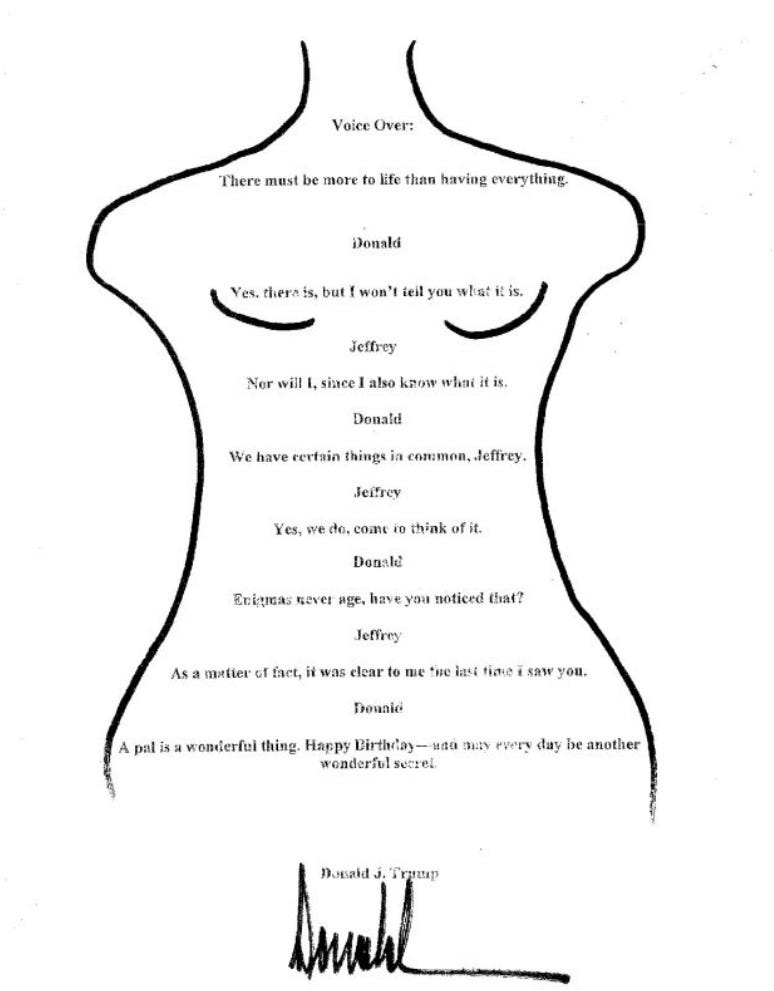
Trump has denied the letter’s authenticity, referring to it as part of the Epstein “hoax,” and even suing Wall Street Journal for referencing the letter in an article last month.
Others were less dismissive. For example, following the release the United Kingdom swiftly removed Mandelson as ambassador to the U.S. over his ties to Epstein. Meanwhile, survivors are compiling their own list of names as the government dithers over what to release.
The mental gymnastics to defend Trump are dizzying. House Speaker Mike Johnson claimed that Trump was an FBI informant who helped expose Epstein. Presidents serving as intelligence sources isn’t unprecedented—Ronald Reagan reportedly did so, and George H.W. Bush once led the CIA, while rumors have long circulated that Bill Clinton worked with intelligence during his time as Arkansas governor. Still, Johnson’s claim was so outlandish he later had to walk it back. Was his initial statement a lie, or was the retraction the lie? Either way, the truth is buried under a mountain of spin.
The Shocking Rise of Censorship in America
Excerpt from Authoritarianism by a Thousand Cuts Power, Fear, and the Death of Dissent? Nolan Higdon Oct 14, 2025 (Link)
This pattern of controlling information and suppressing scrutiny continued with the Epstein case, where leaked materials and political maneuvering revealed attempts to manage public perception. The Epstein case resurfaced in Summer 2025, as leaked materials—including birthday cards and images with Trump—continued to emerge. Reporting from Krystal Ball of Breaking Points suggested that the leaks stopped once Epstein associate and convicted sex trafficker Ghislaine Maxwell began cooperating with the government—implying they may have been intended to secure her a pardon. Meanwhile, congress attempted to block the release of Epstein files by taking summer recess early. Following the September 2025 election in Arizona, in which Democrat Adelita Grijalva was elected to the House of Representatives, enough votes exist to pass a bipartisan bill releasing the files. Yet House Speaker Mike Johnson has refused to seat Grijalva, effectively continuing censorship of the public’s access to these documents.
Meanwhile, Drop Site News reported that prior to this death, Epstein acted as a broker for Israel in securing an international security agreement. CBS separately found that both the original investigation into Epstein’s death and the Trump administration’s 2025 report were deeply flawed, with significant evidence undermining their conclusions. Together, these findings lend weight to claims from Ghislaine Maxwell and Epstein’s brother that Jeffrey did not commit suicide—and underscore the urgent need for greater transparency.
(November 2025) Unmasking Epstein: Power, Blackmail, and the Press’s Failure — A Call for Journalists to Uphold Their First Amendment Duty
For those new to the Jeffrey Epstein story, I’ve compiled my analysis and a helpful timeline of events here.
“President [Trump] Expected to Sign Bill on Release of Epstein Files” read the November 19, 2025 New York Times headline. The report came a day after the House of Representatives passed a bill to release the government’s case files on the deceased convicted sex offender Jeffrey Epstein, with only a single dissenting vote. The Senate followed with unanimous approval. What the files contain, and whom they implicate, remains to be seen. But their impending release marks a pivotal moment in an Epstein saga that has consumed and distorted political discourse throughout the entire first year of Trump’s second presidential term. While much of the coverage frames the release as either a bipartisan effort to seek justice for Epstein’s victims or a political challenge for the president, a far more complex and unsettling question remains largely unaddressed by the mainstream press: Are some of our elected leaders, past or present, compromised by influence operations?
Trump Under Fire
Since Congress returned after the November 2025 shutdown, Trump has responded to the looming release of the Epstein files with efforts to silence dissent. He publicly denounced Representative Marjorie Taylor Greene, who supported releasing the files, as a “traitor.” After Representative Lauren Boebert advocated for releasing the files, he summoned her to the Situation Room, a space typically reserved for high-level classified briefings, in what many viewed as an act of intimidation. He appeared to attempt to purchase silence from convicted, and imprisoned Epstein accomplice Ghislaine Maxwell by refusing to rule out pardoning her for all crimes, and by relocating her to a ‘Club Fed’ facility where she enjoyed extra bathroom breaks, computer access, and even puppies, despite her role in trafficking children.
Pressure on Trump intensified on November 12, 2025, when the House Committee on Oversight and Government Reform released 20,000 pages of documents obtained from Jeffrey Epstein’s estate. They include his communications up until his death in prison in 2019. Trump is referenced 1,500 times in the documents, including Epstein’s claim that Trump liked watching “young women” in Epstein’s pool and “spent hours” in Epstein’s house with one of the victims. By November 18, 2025, the day Congress was set to vote on releasing the files, he lashed out at a Bloomberg reporter who asked about the files by calling her “piggy.” That same day, he threatened an ABC reporter with revocation of their broadcast license for asking about Epstein. Presumably to save face after what was seen as an embarrassing political failure to control his party members, who were set to approve the release, Trump reversed course and supported the release of the files.
With the release of the files now certain, Trump shifted gears, attempting to convince the public that the files were only damaging to Democrats. Trump warned that Democrats would “regret” the release of the Epstein files, an assertion that appears to encompass investigations by the Department of Justice into prominent members of the Democratic establishment mentioned in 20,000 documents: Harvard University’s Larry Summers, LinkedIn founder Reid Hoffman, and former President Bill Clinton.
Upon the release, Summers, who served under both President Bill Clinton and Barack Obama, quickly stepped back from public appearances and resigned from OpenAI’s board. Yet he remains a professor at Harvard University despite email exchanges with Epstein after the sex offender’s 2008 conviction, in which Summers suggested that women had lower IQs than men, and admitted to using Epstein to help him conduct an affair with a woman he referred to as his “mentee.” Meanwhile, Clinton’s spokesperson insisted the emails reveal no wrongdoing on the former president’s part (more on that below), while Hoffman, who connected with Epstein in 2015, seven years after Epstein’s conviction, maintains the relationship was strictly professional, a claim not disputed by the documents reviewed thus far.
Epstein’s Web: Government Ties and Covert Manipulations
While the sordid details of Summers and Trump received a fair amount of media coverage, less was paid to the documents which referenced Epstein’s connections to the Russian, the United States, and Israeli governments. Emails suggest that Epstein may have held compromising information on U.S. politicians that could have been shared with foreign governments, potentially allowing those governments to compromise American leaders. In the emails, Epstein claims to have photographs of Trump with “girls” in “bikinis,” but it is not known if they were under the legal age of consent.
In a series of emails, Epstein claimed that he had been sharing information with Russia about President Trump. A March 2018 email from Epstein’s brother Mark to Steve Bannon asked whether Russian President Vladimir Putin had “the photos of Trump blowing Bubba.” “Bubba” was Bill Clinton’s nickname, though Mark recently insisted that the reference in the email had nothing to do with the former president. The denial only deepened the ambiguity as Mark did not deny that a picture existed. So, did the photo exist? If so, who is Bubba? And if the email was a joke, why did Mark later tell News Nation that “Jeffrey definitely had dirt on Trump?”
More damning emails reveal Epstein’s connections to Israel. Drop Site News cited emails documenting “Epstein’s role in brokering intelligence deals for Israel.” These include facilitating a security agreement between Israel and Mongolia, establishing a backchannel between Israel and Russia during the Syrian civil war, and acting as a facilitator of a security agreement between Israel and the African nation of Côte d’Ivoire. The emails also reveal that Epstein hosted Yoni Koren—a Mossad agent and former aide to Israeli Prime Minister Ehud Barak—at his home. Again, all the evidence mentioned so far is available to the legacy news media, yet they appear unwilling to confront the questions it raises.
Media Blindspots: Ignoring Power in Favor of Partisanship
The legacy press has shown little interest in investigating Epstein’s ties to governments or the broader implications. This was made crystal clear by CNN’s Dana Bash. On November 16, 2025, Representative Marjorie Taylor Greene made headlines when she apologized on CNN for engaging in “toxic” rhetoric. This exchange with reporter Dana Bash received widespread coverage from press outlets and content creators, yet most avoided mentioning what Greene insinuated about Epstein and the intelligence community. It is important to note that Greene serves on the Oversight Committee and therefore is privy to sensitive information regarding Epstein. However, as a politician, her claims should be approached with caution and trusted only when supported by substantial evidence.
During the interview, Bash asked Greene, “You questioned who and what country is putting so much pressure on Trump to keep the Epstein files hidden. And you included a picture about donations from the pro-Israel lobbying group AIPAC [American Israel Public Affairs Committee]. What are you trying to say there?” Greene responded that asking about the intelligence connections between Epstein and Israel is fair, “especially when we saw information recently come out in these emails…We saw Jeffrey Epstein with ties to [Former Israeli Prime Minister] Ehud Barak. We saw him making business deals with them, including deals involving the Israeli government, which seem to have led into their intelligence agencies. I think the right question to ask is: was Jeffrey Epstein working for Israel?”
Indeed, Drop Site News reported on the emails Greene referenced. Fair and Accuracy in Reporting acknowledged the credibility of Drop Site News’s reporting but noted that it was largely ignored by legacy media because, in the months prior, The New York Times repeatedly dismissed claims linking Epstein to Israeli intelligence as “conspiracy theories.” This had the effect of leading audiences to dismiss these accusations based on the outlet’s influence.
Bash, apparently unaware of the evidence that she should have reviewed before asking that question, said, “I just want to be clear. Are you saying Israel is pushing the president of the United States to cover up the Epstein files? And what evidence do you have that that is the case?” This was a strange question, given that Greene had just cited the evidence. Nonetheless, Greene replied, “No, I simply—no, I simply asked.” Which seems to be more than Bash is willing to do. Whether due to ignorance, negligence, or institutional caution, such exchanges illustrate how the press shapes public perception by filtering which parts of the Epstein story are legitimate enough to acknowledge.
The Ethical Crisis: Epstein’s Influence on Power and the Press
The failures extend far beyond CNN. Complicating matters further, in their communications with Epstein, journalists and politicians acted as if it was a fact that Epstein had damning material on Trump, but the revelations were not reported to the public. Take the New York Times’ Landon Thomas Jr., a financial reporter, trusted Epstein as a source for his reporting on Trump between 2015 and 2018. In the emails, Thomas repeatedly referenced Epstein’s alleged knowledge of Trump’s interest in “young women,” including Epstein’s claim that he had “given” Trump one of his former girlfriends. Yet Thomas never reported this information, nor did his colleagues. As Krystal Ball of Breaking Points pointed out, even if Thomas did not report this information, much of this material existed on NYT servers for other reporters to access. Even Thomas was shocked his colleagues did not report on Epstein’s claims. In a damning email from May 2016, Thomas wrote to Epstein, “I am kind of shocked that our reporters did not contact you[.] re the Trump/women story. Seems to me he got off rather lightly.”
Others in the press, such as reporter Michael Wolff, also viewed Epstein as a valuable source for damaging President Trump’s public image. Wolff appears in emails strategizing with Epstein about whether they should provide answers to Trump regarding his relationship with Epstein or let him “hang himself.” It is not clear if Wolff or Epstein or both or neither were communicating directly with Trump at the time.
The documents raise serious questions about journalistic ethics, revealing that both Thomas and Wolff advised Epstein on how to weaponize damaging information about Trump to protect Epstein’s reputation ahead of an upcoming book by thriller author James Patterson and journalists John Connolly and Tim Malloy. Thomas’ relationship with Epstein would eventually bring down his career. He was forced to resign from The New York Times in 2019 after admitting to editors that he solicited a $30,000 donation from Epstein.
It was not only journalists but also at least one politician who recognized Epstein as a valuable source brimming with compromising information. Stacey Plaskett, the delegate from the U.S. Virgin Islands, also seemed to be convinced that Epstein had dirt on Trump. So much so that she live-tweeted with Epstein during a 2019 House Oversight Committee hearing on Michael Cohen, over a decade since Epstein’s conviction, raising serious questions about the proximity between political power and Epstein’s influence.
Conclusion: What the Epstein Files Teach Us About Power and the Press
The legacy news media have long possessed the sources and evidence needed to expose critical aspects of the Epstein saga. Yet much of the story is only now slowly emerging through these recent document releases. Given Epstein’s proximity to power, these revelations will inevitably raise uncomfortable questions for many citizens who have tried to avoid sounding like the internet “cranks” they disdain (believe me, I feel it every time I write about this). The press is constitutionally entrusted to raise these questions responsibly and base their reporting on solid evidence. Transparency about those in power is essential, because sunlight remains the best disinfectant.
Historically, the media has faced justified criticism for mishandling the Epstein story, most famously Amy Robach’s complaint that ABC News “quashed” her Epstein report in 2015. Some journalists, like Dana Bash, choose to ignore glaring facts, while others, such as Megyn Kelly, attempt to minimize the gravity of the issue, equating “barely legal” with Epstein victims as young as 15 years old. Even though 15 is not legal, let alone barley legal. It is also disturbing that entire outlets persist in referring to victims as “young girls” rather than “children,” a dangerous softening of language that should alarm everyone.
Yet for every soft-peddling media outlet, and for every Kelly and Bash, there are courageous reporters producing serious journalism—like the Wall Street Journal’s investigation into Epstein’s birthday book or CBS’s exposé on the suspicious prison video from Epstein’s final days. This kind of fearless reporting is exactly what the public needs. If the president or anyone else, regardless of their political affiliation, is compromised, the public deserves to know. That is journalism’s essential role. So go down that rabbit hole because if the revelations of 2025 teach us anything, it is this: the real danger was never simply what Epstein knew, but what the American media chose to ignore.
(December 9, 2025)
Although some files from the Epstein estate and select government records have been released, more are expected on December 19, 2025. Additionally, last week a Florida judge approved a motion to unseal grand jury transcripts related to the Department of Justice’s Epstein investigation. Meanwhile, key materials, including documents held by Epstein’s lawyer and by figures like Michael Wolff and Steve Bannon, as well as unreleased government and banking records, remain hidden. After years of the news media dismissing those who questioned Epstein’s connections to power as conspiracy theorists, the release of emails has brought prominent and powerful individuals under scrutiny including the artist formerly known as Prince Andrew and Larry Summers to Noam Chomsky, Sarah Ferguson, Donald Trump, Alan Dershowitz, and Andrew Farkas.
The revelations expand our understanding of Epstein’s function as a power broker connecting governments, corporations, intelligence agencies, and political operatives. He played a role in facilitating communication between India’s Modi government and Steve Bannon, pursued financing for Israeli cyberweapons, hosted Israeli operatives, promoted the export of Israeli surveillance technology to Côte d’Ivoire, and helped build diplomatic backchannels between Israel and Russia. He even collaborated with Dershowitz in 2006 to undermine early scholarship on the political influence of the Israel lobby. The recently released images and videos of Epstein’s Virgin Islands estate, including a medical-style chair surrounded by masks, a blackboard covered with redacted names, and records of his contacts, suggest how much more remains concealed. Given the historical record, journalists would be wise to avoid dismissing researchers’ claims as baseless conspiracies and instead follow the evidence.📰
(December 22, 2025) Obfuscation of the Epstein Files
Speaking of Bondi, in the Vanity Fair interview, Wiles argued that Bondi “whiffed” the Epstein investigation. Indeed, Bondi famously said she had the Epstein client list on her desk, only later to say no list existed. She also promised to release the files to the media, but instead released binders full of content already made public to administration-approved sources. Bondi was not the only person in the Administration making false and contradictory claims about Epstein. In September, Patel testified before Congress that there was “no credible information” that Jeffrey Epstein trafficked girls to anyone other than himself. This ignores high-profile cases involving the artist formerly known as Prince Andrew, and Ghislaine Maxwell, which revealed how Epstein recruited girls. When considered with the files released in 2025, it becomes clear that Epstein was involved in trafficking children for others.
The Trump administration has been able to sustain these false narratives with the help of media outlets that repeatedly signal there is nothing to the Epstein case. Let’s not forget that in 2003, Vanity Fair cut allegations of underage girls from a profile of Epstein. In the 2000s, a New York Times reporter who had accepted gifts from Epstein, used his reporting to positively manage Epstein’s public image. Journalist Alan Macleod noted that outlets like HuffPost, Forbes, National Review, and even The New York Times ran puff pieces on Epstein well after serious allegations were made public.
More recently, in a November 2025 column titled “The Epstein Story? Count Me Out,” New York Times columnist David Brooks dismissed the Epstein saga as a “stupid story.” However, people are counting him in as photos of Brooks were found in the Epstein files released on December 18, 2025. Did Brooks really think the story was “stupid” or just problematic for his life and career? More egregiously, earlier in the week, The New York Times published a story titled “Scams, Schemes, Ruthless Cons: The Untold Story of How Jeffrey Epstein Got Rich.” The story is a deeply investigative report that sheds new light on a long-pondered question: how did Epstein amass such significant wealth? The authors write: “In his first two decades of business, we found that Epstein was less a financial genius than a prodigious manipulator and liar.” Ample evidence within the report links his personal associations and actions directly to his accumulation of wealth.
However, the investigative report is tainted by speculative claims, seemingly designed to keep the public from looking further into the matter. The authors write “Abundant conspiracy theories hold that Epstein worked for spy services or ran a lucrative blackmail operation, but we found a more prosaic explanation for how he built a fortune. A relentless scammer, he abused expense accounts, engineered inside deals and demonstrated a remarkable knack for separating seemingly sophisticated investors and businessmen from their money.”
Journalist Ryan Grim commented on the New York Times report, observing that “had the paper decided to look up rather than look down, they may have noticed something a bit more revelatory in their own reporting.” His analysis explains that many of the figures the article links to Epstein are, in fact, connected to intelligence operations, including Stanley Pottinger, “a notable figure in the scandal that became known as Iran-Contra, in which the CIA used Israel as a middleman to move off-the-books weapons to Iran,” and Douglas Leese, whom even the New York Times acknowledged had “extensive connections in the arms industry and the British government.” If anything, the New York Times reporting should raise more questions about Epstein’s connections to intelligence. Grim also noted that the New York Times failed to explain why it is impossible for Epstein to be both a scammer who worked for or with governments and intelligence agencies given that the the Epstein files show him communicating with the Russian, the United States, and Israeli governments. At best, New York Times authors misunderstand and therefore mischaracterize the Epstein researchers they dismiss; at worst, they are running interference for power, much like too many of their predecessors in the media and government.
When Chris Whipple questioned Susie Wiles regarding Trump’s claims about former President Bill Clinton visiting Jeffrey Epstein’s island, she responded, “The president was wrong about that.” Nonetheless, a series of photos, communications, and official records linking Clinton to Epstein were released on December 19, 2025, the final day of the Department of Justice’s (DOJ) congressionally mandated deadline.
The release, while substantial, was only partial; Deputy Attorney General Todd Blanche confirmed that only a fraction of the ‘hundreds of thousands’ of pages were made public, citing the need for further redactions. While only an estimated 10% of the comically redacted files were made public, the release was further marred by reports from NPR that some documents available on December 19 were inexplicably removed within 24 hours, including a photo of “an open table drawer with at least two images of Trump.” This delay sparked immediate bipartisan backlash, with lawmakers like Ro Khanna and Thomas Massie accusing the DOJ of violating the law and threatening impeachment proceedings against Bondi for non-compliance.
Any formal action will likely take weeks. Although Congress was scheduled to be in session the day of the release, House Speaker Mike Johnson adjourned the session a day early. Critics argue this gave members an opportunity to avoid questions about why the Trump DOJ failed to fully comply with the order. These critics contend the release was minimal and strategically focused on Clinton to avoid broader scrutiny.
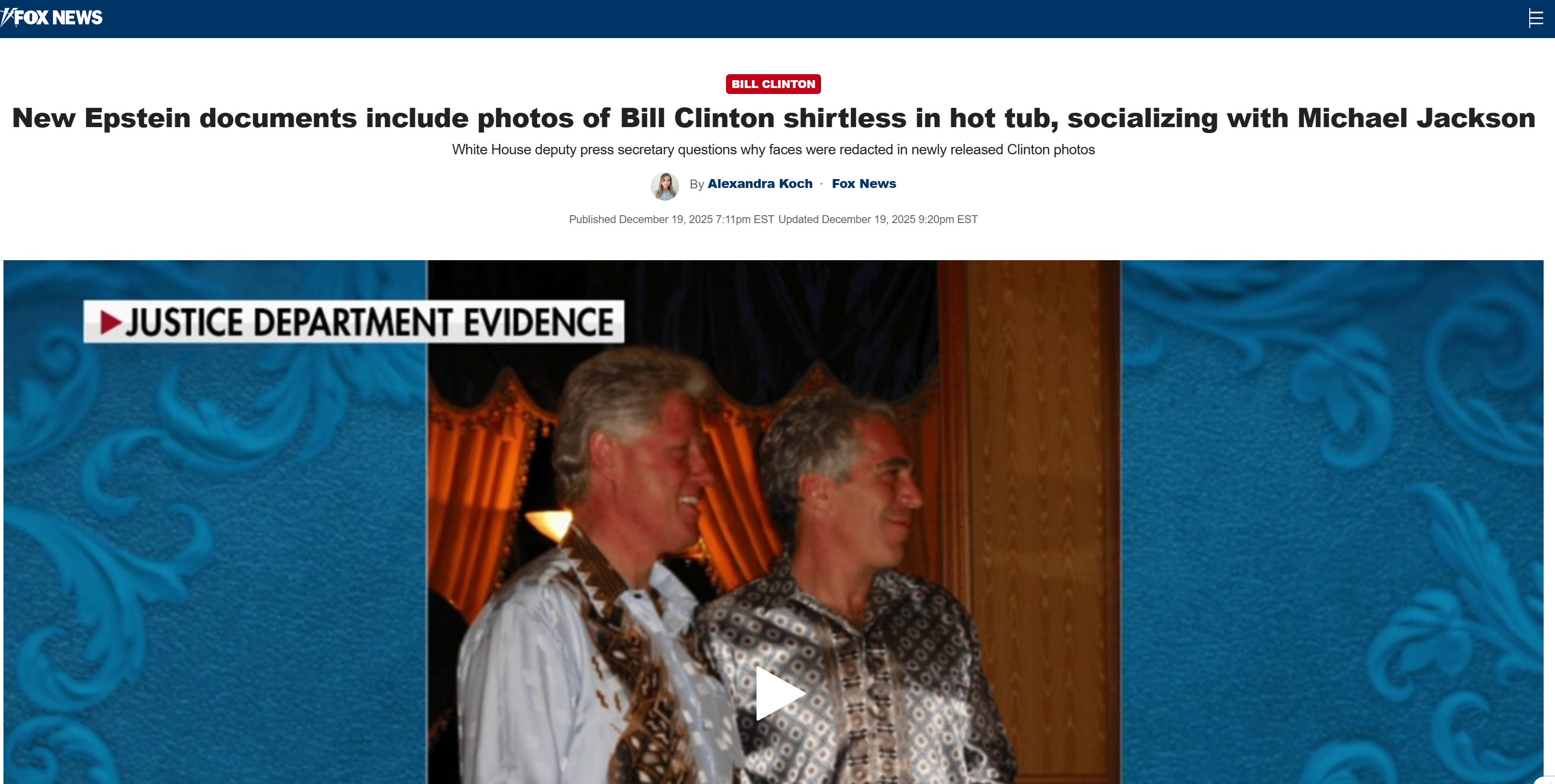
The released materials include images of Clinton with various celebrities and individuals whose faces are redacted, leading some to speculate they are victims. While some conservative news outlets ran with the misleading headline that Clinton was “shirtless” in one photo, the claim sounds more salacious than it is, he is actually in a hot tub and wearing a bathing suit.
In response, a spokesperson for Bill Clinton expressed outrage, accusing the White House of scapegoating the former president by cherry-picking images to divert attention from Trump’s relationship with Epstein. Although the initial release was scant on new details regarding the current president, the files do contain one specific allegation: that Epstein introduced a 14-year-old girl to Trump. While the Clintons maintain they have had no contact with Epstein for two decades, the released communications suggest a more cozy relationship with the Clinton Foundation that persisted long after the 2002 meeting Bill Clinton previously claimed was their final interaction. Furthermore, the documents reveal Epstein’s personal anxiety regarding Hillary Clinton’s 2016 presidential run, as he feared her campaign would bring unwanted global attention to his own activities. Beyond these revelations, the full scope of the records remains murky due to heavy redactions.
Lastly, a key revelation from the documents is the confirmation that survivor Maria Farmer and her sister Annie filed one of the initial complaints against Jeffrey Epstein in the 1990s, during President Bill Clinton’s administration. This claim was widely dismissed at the time, but the newly released files substantiate her account. The files therefore highlight that the necessary evidence to dismantle Epstein’s network was available years before his eventual arrest. This institutional failure suggests that, had there been any genuine political or federal will, the government could have intervened decades earlier to halt his crimes and safeguard his victims.
The Epstein Ledger: Redactions, Revelations, and the Unfinished Dossier (February 2026)

“I didn’t see it myself, but I was told by some very important people that not only does it absolve me, it’s the opposite of what people were hoping, you know, the radical left,” claimed President Donald Trump on January 31, 2026.
He was responding to the release of the latest batch of “Epstein Files” from the Department of Justice (DOJ). A day earlier, the DOJ released over 3 million documents as well as recordings and images related to the now deceased convicted sex offender and financier Jeffrey Epstein. Epstein was a shadowy figure whose wealth and influence positioned him at the center of international finance, intelligence, and elite global cooperation.
Contrary to the administration’s claims of absolution, these documents do not undermine the standing allegations; in fact, they strengthen them. The caches released since December 2025 reveal Epstein as a man whose appetite for sex and power allowed him to cultivate a network of relationships that, when coupled with his communications, place him at the intersection of global intelligence gathering, blackmail, and high-level financing for the world’s most powerful individuals.
Strategic Obstruction: The War Over Redactions and Missing Records
While the White House was legally mandated to release these documents by December 19, 2025, under the Epstein Files Transparency Act, a bill Trump signed into law, the rollout has been defined by delays and controversy. The administration’s “compliance” with the law has been questionable at best. Despite White House claims that this batch fulfills their legal obligations and concludes the file dumps, millions of documents remain hidden. The DOJ is estimated to hold at least three million more pages, and Senator Ron Wyden continues to fight for the release of critical financial records. Furthermore, files from the Epstein estate have already begun leaking to outlets like Drop Site News, much to the chagrin of the Trump Administration.
To make matters worse, on Christmas Eve 2025, the DOJ abruptly announced the discovery of “a million more documents” related to the Epstein case. This reversal came just after the department had publicly claimed that nothing in the existing files warranted further investigation. Reporting indicates that the news of the discovery left President Trump furious, as the sudden influx of evidence directly contradicted the administration’s narrative that the matter was settled.
The release process itself has been a catastrophic failure of basic media literacy and data security. Internal emails revealed the DOJ was scrambling for holiday volunteers to handle redactions, leading to thousands of failures that have resulted in death threats against survivors. The administration initially claimed they were withholding files to protect survivors; however, the reality has been the opposite. Numerous survivors’ names were left unredacted, and explicit images, including ones where survivors are nude, were released without protection. As a result, survivors report receiving death threats.
In some instances, “redacted” text could be revealed simply by copying and pasting the document from one file to another, as the government failed to properly flatten the digital files. In perhaps the most embarrassing oversight, Drop Site News managed to access a batch of files early simply by guessing the government’s insecure web address. The administration’s haphazard approach suggests either a profound lack of technical competence or a deliberate attempt to muddy the waters of a historic transparency effort.
The Blackmail Engine: Extortion as a Tool of Global Policy
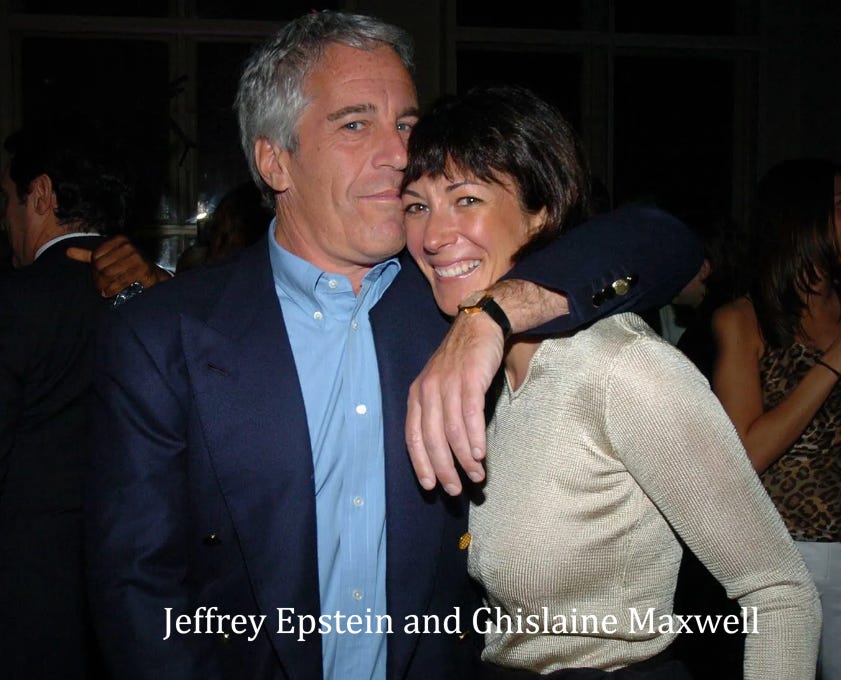
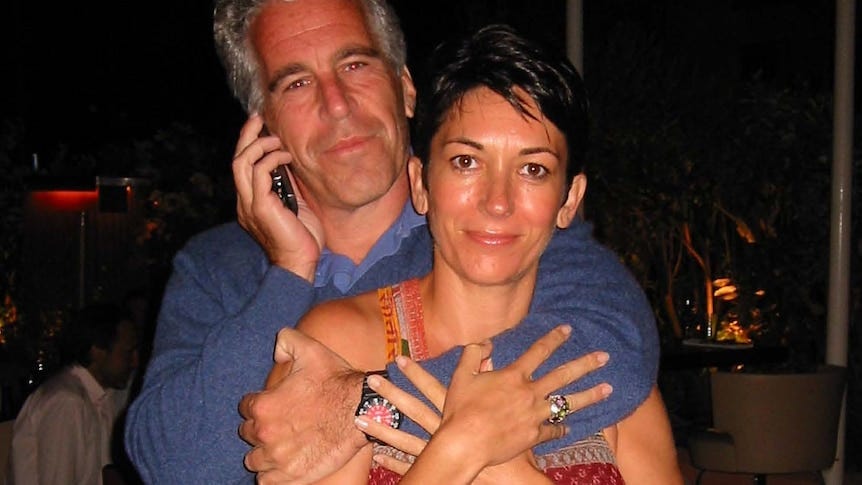
The portrait of Jeffrey Epstein that emerges from the latest document release is one of a man who integrated sexual predation with sophisticated methods of international influence. It is now clear that Epstein leaned on a devoted coterie of employees and associates to facilitate his operations. Most notably, British socialite Ghislaine Maxwell worked to secure a steady supply of minor victims, often enlisting the victims themselves to recruit other girls under the false pretense of providing massages. His Amazon purchases, including orders for schoolgirl uniforms and specialized medical devices, appear to substantiate these predatory behaviors.
Beyond his sexual crimes, Epstein’s personal history suggests a deep preoccupation with surveillance and tradecraft. His purchase history includes an unusual fixation on optics, with records showing he ordered seven pairs of high-end binoculars to his Manhattan home, which was equipped with cameras, over a five-year period. This interest in monitoring others is reinforced by a 2017 Federal Bureau of Investigation (FBI) informant claim that Epstein employed a personal hacker. The hacker in question was allegedly an Italian citizen who specialized in developing offensive cyber tools and zero-day exploits for mobile devices, which many observers view as evidence that Epstein was actively collecting digital intelligence on his powerful associates. Adding to the aura of international espionage, investigators discovered a fraudulent Austrian passport in Epstein’s safe that featured his photograph under the alias Marius Robert Fortelni and listed his residence as Saudi Arabia.
While it remains uncertain whether these surveillance tools served as the foundation for a strategic global blackmail scheme, the files provide concrete evidence of Epstein engaging in direct attempts at extortion. The files provide a concrete example involving Microsoft’s Bill Gates, whom Epstein reportedly attempted to extort regarding an extramarital affair. Draft emails discovered in the files show Epstein writing to himself as if preparing messages for Gates. Within the files, a draft resignation letter from the Bill & Melinda Gates Foundation appears to serve as a tool for extortion, citing the procurement of medication for Gates to manage the consequences of sexual encounters with a Russian women. Another draft accused Gates of ending their friendship while repeating lurid claims about a sexually transmitted infection. While spokespeople for Gates have denied these allegations, it has been widely reported that these ties contributed to the dissolution of his marriage to Melinda French Gates.
Perhaps even more damning is an exchange from 2015 in which Epstein reached out to a Russian contact for advice on how to neutralize a woman who was allegedly attempting to blackmail a group of powerful businessmen in New York. Epstein provided the woman’s specific address writing
“how are you , I need a favor , there is a russian girl from moscow. , she is attempting to blackmail a group of powerful biznessman in New York, it is bad for business for everyone involved. she arrived new york saturday of last week staying at the Four Seasons. on 57 street. . Suggestions?”
This interaction has led many to view Epstein not just as a financier, but as a point person for intimidating or silencing potential whistleblowers.
The documents also reignite the controversy surrounding Epstein’s death, which was officially ruled a suicide but has been plagued by questions regarding malfunctioning cameras and the absence of cellmates. The files reveal that at the time of his death, investigators did not believe the note he left was a suicide note. Furthermore, the timeline regarding when cameras stopped and started working remains riddled with inconsistencies between government statements and the recently released footage.
Complicating the record further are several fraudulent documents that surfaced during the investigation, including a fake suicide video found on the dark web and a letter purportedly written by Epstein to serial child molester Larry Nassar. The letter, which referenced the President’s own preferences, was postmarked three days after Epstein’s death and dismissed by the DOJ as a forgery.
Ultimately, the most significant challenge to the suicide conclusion is the evidence of Epstein’s mindset in his final days. Documents show that less than two weeks before he died in 2019, his attorneys met with Manhattan federal prosecutors to discuss a potential resolution of his case. An FBI summary explicitly states that on July 29, 2019, the defense and prosecution discussed the possibility of Epstein’s cooperation. This revelation suggests that at the very moment Epstein was considering sharing what he knew about his powerful network, the security systems meant to keep him alive suffered a total and convenient collapse. This has led some, such as Epstein’s brother to conclude that suicide was not the cause of death.
The Web of Prestige: Academia, Entertainment, and Intellectual Blackmail
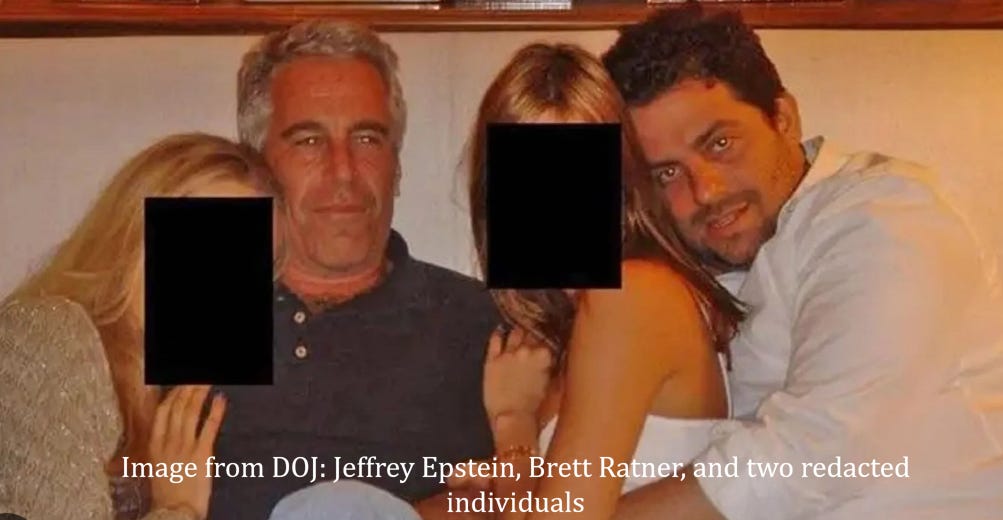
The newly released documents extend far beyond Epstein’s immediate circle, revealing a sprawling network of influence that reached into the highest echelons of academia, entertainment, and international diplomacy. In the academic world, records confirm contact with Harvard University’s Steven Pinker and Martin Nowak, while Case Western Reserve University physics professor Lawrence Krauss reportedly sought Epstein’s advice on responding to sexual misconduct allegations. Epstein also maintained surprisingly candid interactions with Harvard’s Larry Summers—whose recent resignation from the OpenAI board and leave from Harvard followed the release of files detailing their close correspondence. In these exchanges, Summers expressed personal frustrations to Epstein regarding the shifting Democratic Party landscape and his children’s preference for Bernie Sanders’ platform. Perhaps most bizarrely, records show that Epstein sent DNA test kits to both Noam Chomsky and Woody Allen, a detail that adds a strange layer of personal biological inquiry to his long-standing intellectual associations.
The entertainment and sports industries were similarly entangled in this web of correspondence. Brett Ratner, the director behind a recent documentary on Melania Trump, appears in the files through a photograph with a young girl, while Casey Wasserman, the head of the Los Angeles Olympics organizing committee, is shown to have exchanged provocative emails with Maxwell. In these messages, Wasserman openly expressed his desire to see Maxwell in leather attire, and she in turn offered him a massage designed to drive a man wild. Though Wasserman has since expressed deep regret and claimed his interactions occurred long before her crimes were known, the emails highlight the casual nature with which Epstein’s inner circle integrated into elite social circles.
Similarly, New York Giants co-owner Steve Tisch appears in hundreds of documents from 2013 that suggest Epstein was facilitating introductions between Tisch and various women. These exchanges included Epstein providing personal assessments of the women’s appearances and backgrounds, with Tisch participating in discussions about their professional status and trustworthiness.
Media and journalism were not immune to this influence, as evidenced by Epstein’s relationship with author Michael Wolff. The files suggest that Epstein acted as an informal editor for Wolff, specifically refining passages meant to damage Trump’s public image by framing his real estate business as a vehicle for money laundering. In a contradictory twist, another email from Epstein to Wolff claimed that Trump had visited Epstein’s home numerous times while a specific woman worked at Trump’s Mar-a-Lago property, yet Epstein noted that Trump “never got a massage.” The files also shed light on the priorities of media figures like CBS contributor, physician and author Peter Attia, who allegedly prioritized a meeting with Epstein over his own wife’s pleas to join her at the hospital where their infant son was being treated for a life-threatening illness.
The Fixer’s Reach: Bridging British Royalty and Middle Eastern Diplomacy
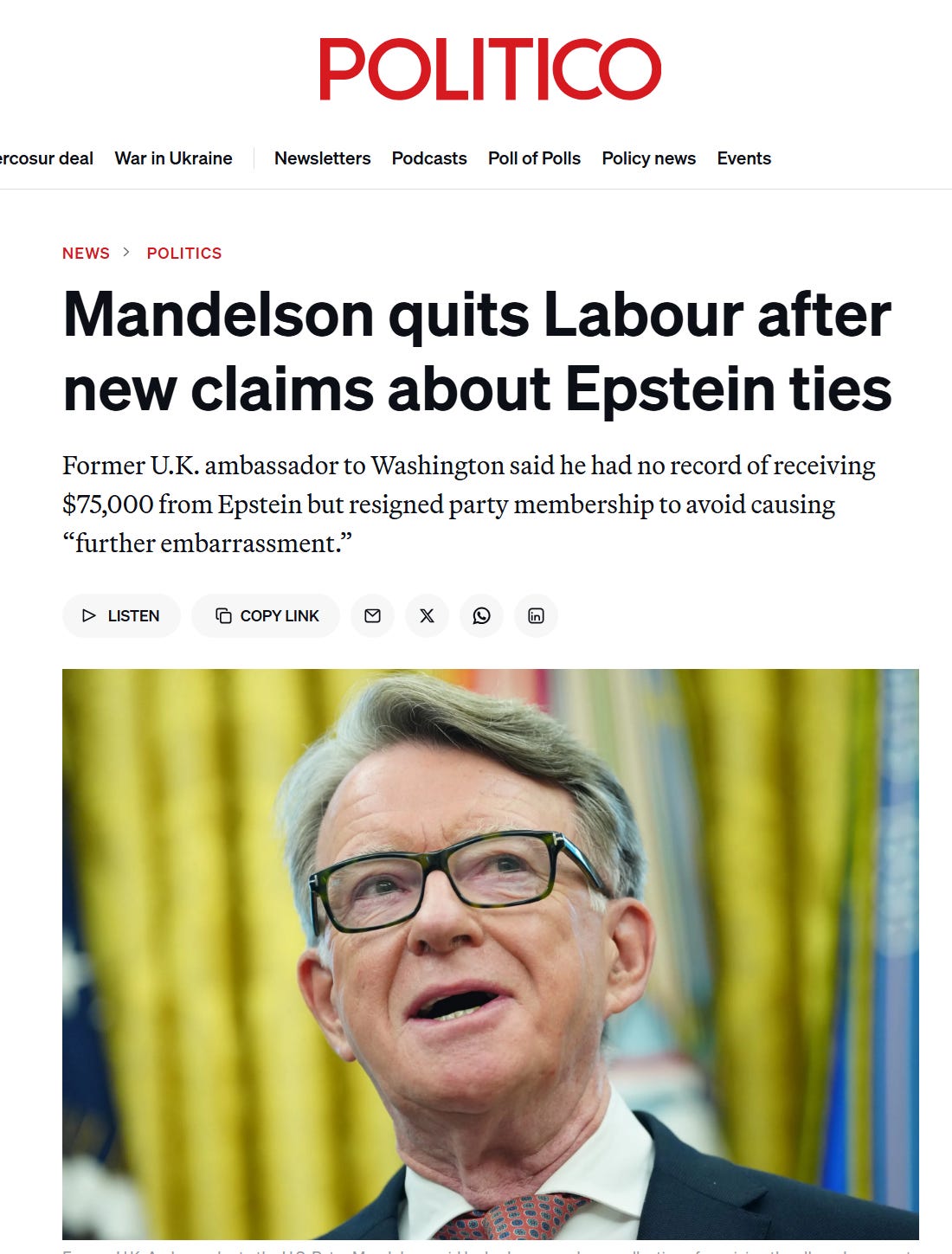
The documents further illuminate Epstein’s role as a high-level international fixer for royalty and world leaders, revealing ties that persisted long after he became a registered sex offender. Emails suggest that Andrew Mountbatten-Windsor invited Epstein to Buckingham Palace for private dinners shortly after Epstein’s 2010 release from house arrest, and the files include new photographs that appear to show the former prince on all fours over an unidentified woman. This pattern of elite access extended to the highest levels of British and European politics, most notably involving former cabinet minister Peter Mandelson.
The latest revelations led to Mandelson’s resignation from the Labour Party on February 1, 2026, following the release of bank records from Epstein’s JP Morgan accounts. These documents appear to show three separate payments of $25,000 referencing Mandelson, alongside evidence that Epstein wired thousands of pounds to Mandelson’s husband for educational expenses in 2009. While Mandelson has claimed he has no recollection of these sums and questioned the authenticity of the records, the files also include a compromising image of him in his underwear standing next to a woman whose face is redacted. Mandelson has stated he cannot place the location or the circumstances of the photograph, which surfaced just months after he was dismissed from his role as ambassador over his historic links to the financier.
Similarly, the fallout has reached the Slovak political sphere, where Miroslav Lajčák has also resigned his position following the disclosure of his correspondence with Epstein. The files show Epstein and Lajčák bantering about women while discussing high-level diplomatic meetings with Russian Foreign Minister Sergey Lavrov.
The files revealed an odd exchange from 2012 in which the Crown Princess of Norway, Mette-Marit, asked Epstein, who was then a registered sex offender, for parenting advice about showing her 15-year-old son naked women. Mette-Marit told Epstein he was “very charming” before inquiring whether it was “inappropriate for a mother to suggest two naked women carrying a surfboard for my 15 yr old sons wallpaper?”
In addition to association, Epstein had sway with Europeans as well. Documents show Epstein using his contacts to facilitate meetings for associates such as Steve Bannon with European government leaders. Other documents show Epstein scheduling meetings by email with the secretary general of the Council of Europe, Thorbjөrn Jagland. These interactions suggest that Epstein functioned as a shadowy conduit for some of the most powerful people on earth, leveraging financial favors and personal relationships to ensure his place at the center of global institutional power until his final days.
The American Nexus: Intelligence Assets and Political Entanglements
The documents also shed new light on the institutional failures and personal entanglements that allowed Epstein to operate with impunity for decades. Documents show how his legal team continued to exert influence over federal prosecutors long after his initial plea deal was finalized, maintaining a blurred line between professional and personal relationships with the very attorneys assigned to his case.
This atmosphere of mutual familiarity may help explain the actions of former U.S. Attorney Alex Acosta, who famously shifted from a confident pursuit of a full indictment to an unusually secretive and favorable plea agreement for Epstein, widely referred to as a sweetheart deal. Reporting indicated that Acosta claimed in 2016 or 2017 that the government forced him to make the sweetheart deal because he was told Epstein was an intelligence asset, something he denied in 2025. However, the latest batch of files include a 2007 prosecution memo that shows a detailed case that was never pursued in court, raising persistent questions about the external pressures that may have derailed the original federal investigation.
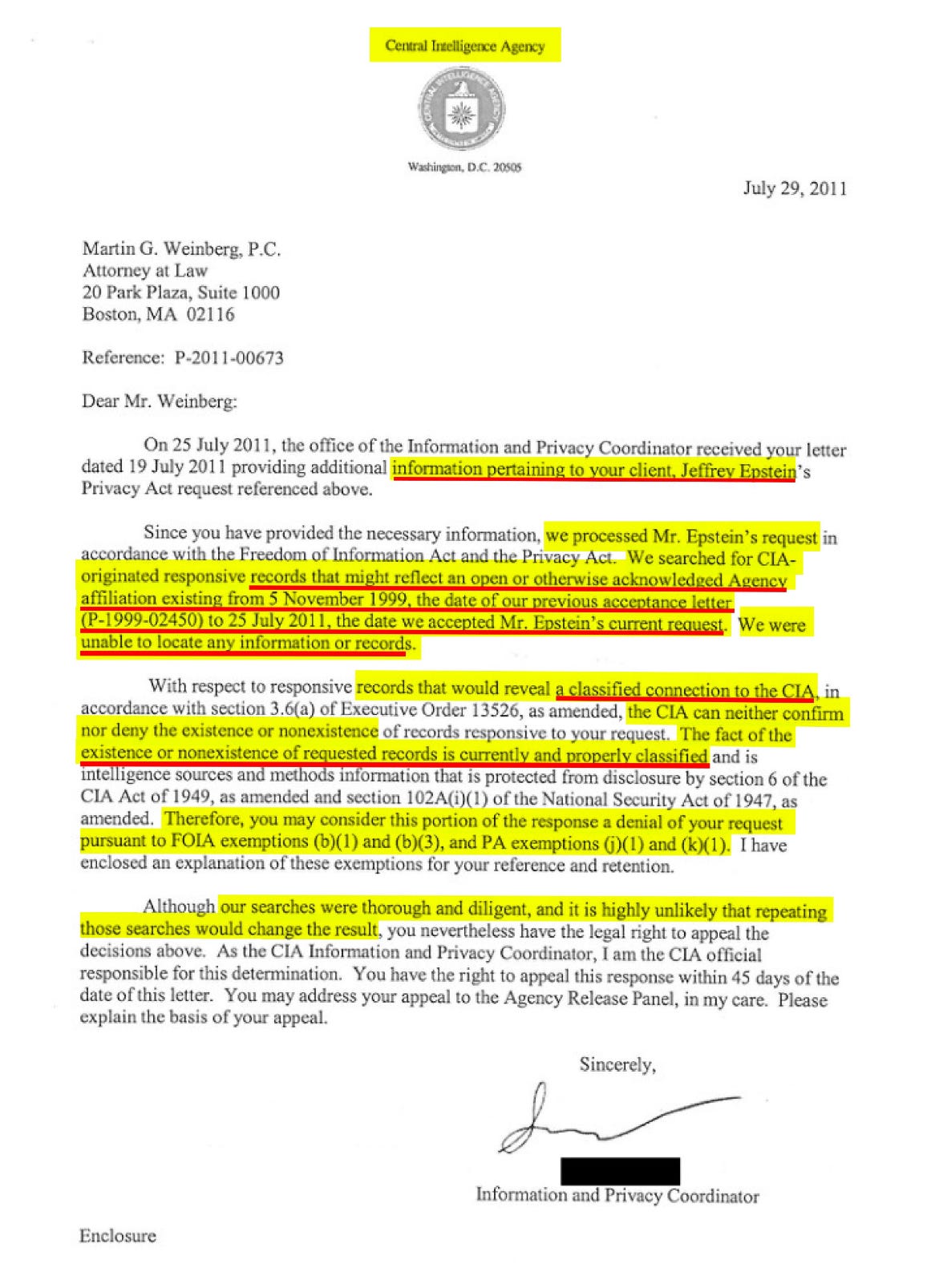
Epstein’s role as an international intermediary is further detailed in records showing his attempts to broker high-level connections between former Israeli Prime Minister Ehud Barak, who served as the head of Aman, the Israeli Military Intelligence Directorate from 1983 to 1985, and former Central Intelligence Agency (CIA) Director Michael Hayden. Epstein also expressed concern regarding the existence of government records detailing his relationship with the CIA. To address this, he initiated an information request with the CIA to determine if any records existed “that might reflect an open or otherwise acknowledged Agency [CIA] affiliation existing from 5 November 1999... to 25 July 2011.”
Audio from 2013 reveals Epstein attempting to persuade Barak to collaborate with Palantir, the data-analytics giant co-founded by the influential and often controversial Peter Thiel. In a December 17, 2018, email exchange, Epstein and Barak discussed their perceived associations with Israel’s intelligence agency, Mossad:
Epstein: unfortunately, not. &nbs=; you should make clear that i dont work for mossad. :)
Barak: Yo= or I?
Epstein: that I dont :)
These geopolitical ties are complicated by confidential human source reports that attorney Alan Dershowitz, Sheldon Adelson, Sean Hannity, and Epstein all collaborated together with Mossad. Documents reveal that the informant alleged that attorney Alan Dershowitz was viewed as a figure controlled by Israeli interests and backed by figures like Sheldon Adelson. According to this federal informant, Dershowitz’s eventual shift in support toward Trump was seen not as a political evolution but as a calculated alignment with the preferences of the Israeli government. The files also suggest that influential media figures like Sean Hannity shared similar financial backing from the same billionaire circles. The informant claims that Maxwell and Epstein were not billed for the work performed by Dershowitz’s office.
Internal White House dynamics were also touched by Epstein’s orbit, specifically through his surprisingly close relationship with Bannon. It has been known for a long time that Bannon was helping produce a documentary aimed at rehabilitating Epstein’s public persona before he died. The files include hours of never-before-seen video from that documentary, which among other things show Epstein struggling to directly answer whether or not he is the devil. Nonetheless, the recent documents reveal a much deeper relationship between Bannon and Epstein. The two shared numerous text messages covering everything from television preferences to specific White House policies, even after Bannon’s departure from the first Trump administration. In these private exchanges, they frequently mocked President Trump, with Epstein suggesting that Trump should be termed a “re-grifter” rather than a regifter. Bannon countered with his own derisive monikers, referring to President Trump as a “stable genius” and remarking that he was “out of gas” in response to reports about his limited work schedule.
The released documents have proved particularly damaging for current and future administration officials who previously sought to distance themselves from the financier. In 2025, Commerce Secretary Howard Lutnick had publicly claimed to be so disgusted by a 2005 meeting with Epstein that he vowed never to be in the same room with him again. However, 2012 emails show Lutnick and his wife meticulously coordinating the logistics of docking their 188-foot yacht at Epstein’s private island for a scheduled lunch. The next day, a message from Epstein to Lutnick read “Nice to see you.” Similarly, Kevin Warsh, a prominent pick for the Federal Reserve, attended a large event alongside Epstein.
Elon Musk appears in the files as having once said he “declined repeated invitations” to visit Epstein’s island. However, the documents suggest he tried multiple times to meet Epstein there, going so far as to bemoan on Christmas morning how he could not wait to get away from his children and join Jeffrey. Additionally, while Musk claimed he had no knowledge of Epstein touring SpaceX, emails reveal that Musk confirmed the tour of SpaceX and Epstein thanked him for it.
Thiel and Musk are not the only members of the ‘PayPal Mafia’ appearing in the Epstein files; they also reveal a relationship between Epstein and Democratic Party megadonor and LinkedIn co-founder Reid Hoffman. Hoffman has publicly expressed “deep regret” for his past association with Epstein, which involved multiple interactions and a trip to Epstein’s private island, Little St. James, in 2014. These documents clarify that Hoffman’s involvement was tied to fundraising for the MIT Media Lab, culminating in his presence at the Lab’s controversial 2016 “Forbidden Research” symposium. At this event, Hoffman was the primary funder for the launch of the $250,000 “Disobedience Award,” a prize introduced during a schedule that notably included a panel on “Sexual Deviance” and the use of technology to address pedophilia. Internal MIT reports further reveal that the Lab’s director sought Hoffman’s advice on whether to invite Epstein, who was at that time a registered sex offender, to this very conference. While separate logs from the period show that Epstein had even come into possession of Hoffman’s passport.
The shadow of the investigation continues to loom over former presidents as well, with flight records and damning photos indicating that Bill Clinton remained firmly within Epstein’s social sphere. The ongoing refusal of both Bill and Hillary Clinton to comply with congressional subpoenas has created a significant rift within the Democratic Party, pitting an older establishment against younger members demanding accountability.
The Mar-a-Lago Dossier: Surveillance, Redacted Crimes, and the Greene Defection
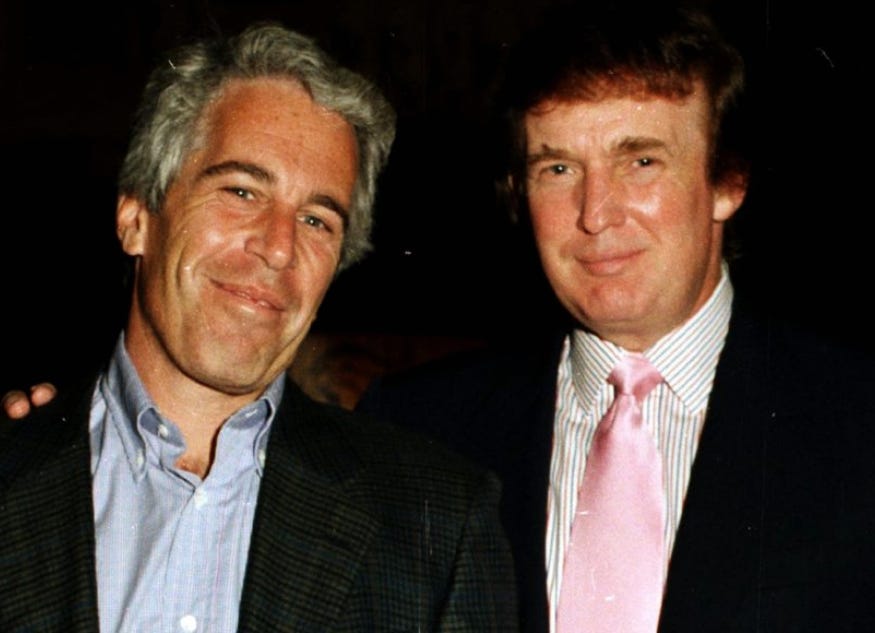
In addition to former President Clinton, current President Donald Trump is in the new files as well. It was known previously that the Trumps were close with Epstein and Maxwell, but the documents reveal a deeper look with Melania writing a fawning email about Epstein and Maxwell in 2002. Other documents reveal that Trump flew on Epstein’s private jet at least eight times between 1993 and 1996, a much higher frequency than previously acknowledged. These flights often included Maxwell and, in one instance, a 20-year-old passenger whose identity remains undisclosed.
The most unsettling entries in the DOJ’s disclosures involve a specific tranche of investigative materials that point to a landscape of extreme violence and intimidation. In August 2025, federal officials, whose names are redacted, assembled a structured summary, essentially a spreadsheet, of more than a dozen tips and unverified allegations specifically regarding Trump and his interactions with Epstein. The day the files were released, this file was briefly taken down by the DOJ. Among the entries are reports that Trump engaged in the forcible rape of young women, made threats against underage girls, and maintained properties where sex crimes and coercion occurred. The summary claims that these tips were later determined to be false. Another person reported that Trump raped her when she was 13 years old. Another said that after being sexually assaulted by Epstein she was “presented” to Trump by Ghislaine Maxwell for a private tour of his Mar-a-Lago property. One particularly harrowing tip included in the files involves an allegation from a woman who claimed Trump witnessed the murder and disposal of her newborn baby in Lake Michigan during a trafficking ordeal in the 1980s. Deputy Attorney General Todd Blanche has dismissed these entries as unfounded or “sensationalist” claims submitted by the public.
The files also reveal that Trump was monitoring the Epstein story during his first term. At the time, his administration was monitoring the travel and flight records of Julie K. Brown, the primary investigative journalist who broke the Epstein scandal open. This surveillance of a member of the press has raised grave concerns about the use of state resources to track those investigating the financier’s inner circle.
In his second term, Trump has relied on the courts to simmer down public disclosure. This includes a billion-dollar defamation suit by Melania Trump against journalist Michael Wolff. Wolff has since countersued, essentially arguing that the administration is using “Strategic Lawsuits Against Public Participation“ or SLAPP tactics to silence his reporting on Epstein’s efforts to leverage information against the President. The lawsuits continue as on February 1, Trump threatened to sue Wolff.
The internal fallout from these files has exposed deep rifts even among the President’s most loyal allies. Representative Marjorie Taylor Greene has publicly broken with the administration, claiming that Trump yelled at her for demanding full transparency because his “friends” would get “hurt” by the revelations.
The Unfinished Ledger: Why the Epstein Narrative Remains Broken
The recent disclosures and the reporting they have sparked continue the unsettling pattern of the Epstein saga, ultimately providing more questions than answers. While the files confirm that the government identified ten indicted co-conspirators, the complete list remains shielded from the public eye. Of these individuals, only three names were released without redaction: retail magnate Leslie Wexner; French modeling agent Jean-Luc Brunel, who died in a Paris jail cell in 2022 while awaiting trial; and Ghislaine Maxwell. This lack of transparency is compounded by Maxwell’s recent court filings, in which she claims that at least twenty-five other accomplices secured secret settlements with the federal government to avoid prosecution.
When Epstein died, he left behind a significant fortune amassed during a decades-long ascent from high school math teacher to the financial confidant of the global elite. Two days before his death, Epstein put his fortune into a trust, making it more difficult for survivors to access. His last will and testament, included in the new documents, offers an evolving list of power players who remained part of his life until the very end. The orchestration of his estate suggests a man who may have accumulated wealth specifically to serve the interests of his associates, an arrangement he seemingly delivered upon in his final acts.
The legal fallout, however, is now moving beyond the individual to the institutions that facilitated his rise. Just last week, a federal judge ruled that a lawsuit brought by Epstein’s victims against Bank of America can proceed, allowing claims that the bank knowingly benefited from and facilitated sex trafficking to move toward discovery.
There is a grim irony at the heart of the current document dump: in a supposed democracy predicated on transparency, it has proven far easier for a citizen to find the names and compromising images of survivors than the names of high-level accomplices.
The fact that the government has struggled to protect the privacy of survivors while successfully shielding Epstein’s most powerful enablers tells you everything you need to know about this case. It is this fundamental imbalance, the exposure of the vulnerable and the protection of the powerful, that ensures the public will remain deeply interested, frustrated, and profoundly skeptical of the official Epstein narrative.
The Epstein Class: Shielding the Architects of the Second Gilded Age (February 11, 2026)
Notice: My goal is to provide fresh insights with every post. This article focuses exclusively on new developments regarding the Epstein Files. For a comprehensive background on the saga, please visit our [full archive here]; the most recent updates are located at the bottom of the page.
“By some baffling twist of logic, it concluded that Oakes was guilty of offering bribes but that no one was guilty of accepting them,” wrote historian Maury Klein regarding the Credit Mobilier scandal. During the late 19th century, financial elites bribed lawmakers to maximize industrial profits through state-sponsored projects. Despite the widespread attention to the scandal and a congressional investigation, none of the lawmakers were prosecuted for their role. It is no wonder that this era, dubbed the “Gilded Age” by Mark Twain, was defined by the American public’s growing realization that concentrated wealth had catalyzed the corruption and erasure of democracy. The Credit Mobilier scandal is known as “the signature scandal of the Gilded Age.”
Over 150 years later, the startling lack of accountability in the United States following the revelations from the Department of Justice (DOJ) files on convicted sex offender Jeffrey Epstein makes it clear why many have labeled our current era “The Second Gilded Age.” The release of the Epstein files has exposed a web of high-powered lawmakers, financial titans, media personalities, and intelligence officials engaged in a spectrum of corrupt and immoral behavior, ranging from financial crimes to systemic sexual abuse. Yet, instead of justice, the headlines tell a story of domestic stagnation: “Epstein revelations have toppled top figures in Europe while US fallout is more muted” and “The Epstein scandal is taking down Europe’s political class. In the US, they’re getting a pass.”
While other nations have made strides toward accountability and the shunning of disgraced figures, the U.S. response has devolved into a partisan circus. On one side, Make America Great Again (MAGA) loyalists suggest that the mountain of unreleased and redacted documents somehow absolves President Donald Trump of wrongdoing, despite evidence to the contrary. On the Democratic Party side, Bill and Hillary Clinton seek to dismiss congressional investigations into their relationship with Epstein as a partisan distraction. In reality, both factions, and numerous others, evade the accountability that a functioning democracy requires.
The Redacted Republic: Weaponized Secrecy and the Shield of State
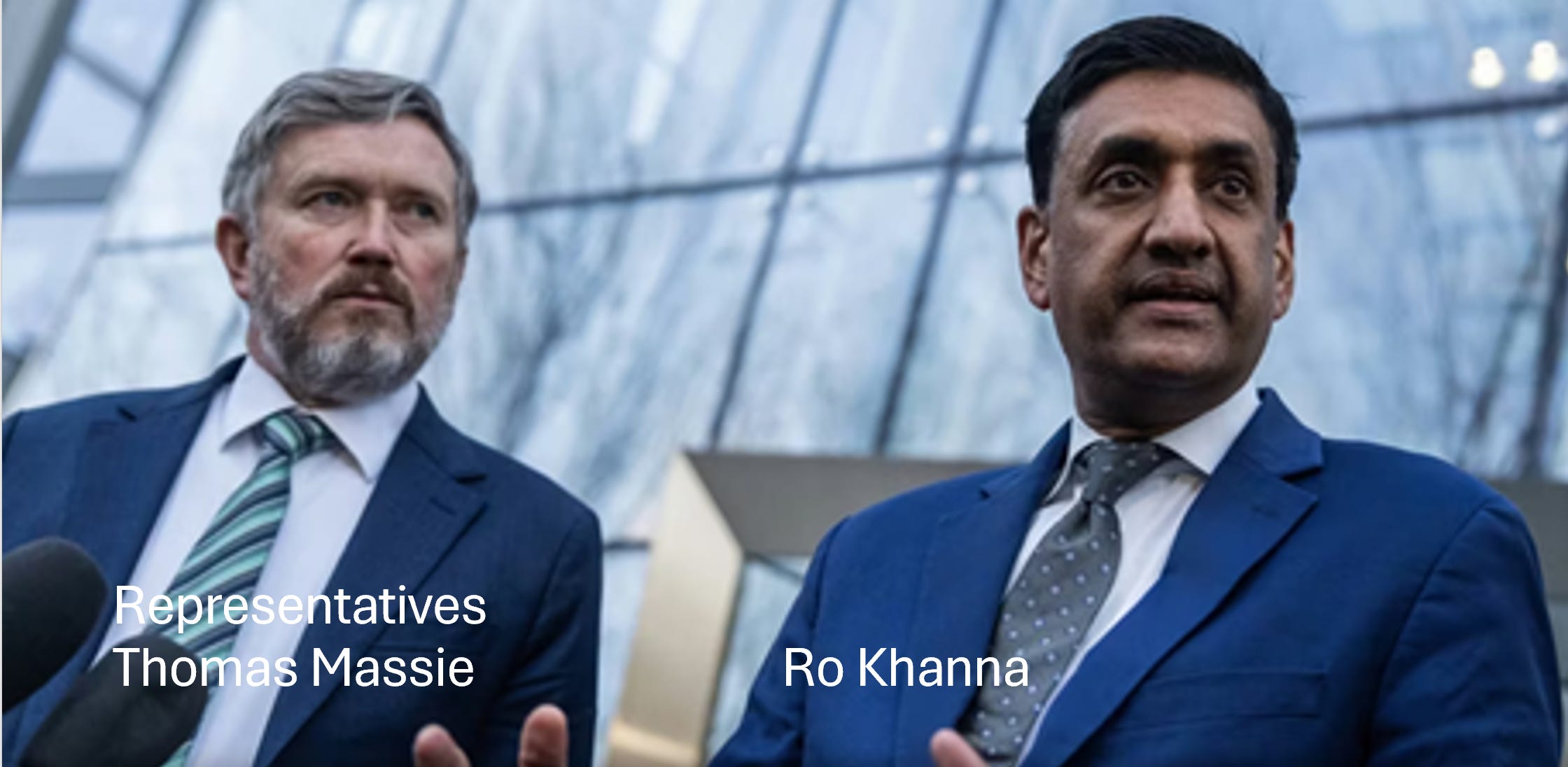
While the Epstein Files Transparency Act explicitly prohibited withholding records based on “embarrassment, reputational harm, or political sensitivity,” it permitted exceptions for content that “depict or contain child sexual abuse materials (CSAM),” “contain personally identifiable information of victims or victims’ personal and medical files,” or “would jeopardize an active federal investigation.” However, even the DOJ admits that the survivors, whom the redactions were ostensibly designed to protect, have been failed by the system as their names and nude images were made public. Simultaneously, there is mounting evidence that these redactions were weaponized to shield criminals rather than victims. Meanwhile, there are millions of files that have not been released, including those pertaining to the review of the files conducted by Bondi, Patel, and Deputy Attorney General (DAG) Todd Blanche upon taking office last year.
The documents themselves paint a grim picture, offering a volatile mix of damning evidence against the powerful and a growing litany of unanswered questions. However, there are an estimated 3 million files that have not been released, not to mention documents from the Epstein estate and financial records. Some of what is being withheld appears to be even more damning. In January 2026, Deputy Attorney General Todd Blanche confirmed that the DOJ utilized the exceptions in the legislation to exclude images and videos depicting “death, physical abuse, or injury.” This admission suggests that the archives harbor a much darker reality of torture and violence than the public has been permitted to see, even as the released materials consistently reference such horrors.
Despite the visceral nature of these withheld records, top government officials have maintained a strikingly dismissive public stance regarding their significance. As early as September 2025, Federal Bureau of Investigation (FBI) Director Kash Patel stated that the files contain “no credible information” that would warrant an investigation or conviction. His comments were echoed by Attorney General Pam Bondi and FBI Deputy Director Dan Bongino. For nearly a year now, President Donald Trump himself has claimed that there is nothing in the files and the story is a waste of time. However, one of the things that becomes very clear when reading the files is that many of the redactions do not pertain to survivors.
Upon reading the files, it becomes clear that the federal government believed there were at least 10 unindicted co-conspirators associated with Epstein, but their names were redacted. The only co-conspirator convicted of sex trafficking, Ghislaine Maxwell, claimed that 25 others received deals with the federal government to avoid prosecution. Maxwell recently pleaded the Fifth Amendment in a deposition to Congress, and her lawyer admits if Trump pardons her, she will “tell all,” which she claims will clear both Trump and former President Bill Clinton of wrongdoing.
In addition to Maxwell, it was believed that one of the co-conspirators on the list of 10 was Jean-Luc Brunel. Brunel was allegedly central to a scheme to traffic young women through international beauty pageants and ultimately met his end in a manner similar to Epstein’s own death in custody. Another is Les Wexner, the former head of the L Brands (Victoria’s Secret) empire, who contributed to Epstein’s massive wealth, including the Manhattan residence.
While other names remained hidden, members of the United States Congress, including Representatives Thomas Massie, Ro Khanna, and Jared Moskowitz, have since reviewed the unredacted files. They were permitted to do so under strict protocols, using only limited resources like a notepad, and warned they would begin reading names aloud if they were not formally unredacted. Rep. Moskowitz said on CNN, “I saw a worldwide sex trafficking ring with people in other countries sourcing young children for Jeffrey Epstein, co-conspirators’ names, men and women, clearly other people that might be on the client list that are on text messages and emails, overredaction, dramatic overredaction.”
It has long been reported that modeling agencies and beauty pageants served as fronts to lure victims into Jeffrey Epstein’s trafficking circle. While Les Wexner held significant influence in the modeling industry, Jean-Luc Brunel and Donald Trump were both deeply involved in the pageant world. In 2016, a woman using the pseudonym “Katie Johnson“ (also referred to as “Jane Doe”) filed lawsuits against Trump and Epstein. She alleged that both men raped and sexually assaulted her in 1994, when she was 13 years old. The recently released files shed little light because many communications that allude to sex with “girls” are redacted. For example, a redacted person in 2014 wrote to Epstein: “Thank you for a fun night... Your littlest girl was a little naughty.”
Adding a layer of opacity to the records is the frequent use of coded terminology; for instance, seemingly mundane references to “pizzas” are widely interpreted as euphemisms for the presence of women and minors. In another exchange, it seems that Epstein and Olivier Colom, a former French diplomat, are using “sharks” and “shrimp” as interchangeable codes for girls. Epstein refers to his sharks as being “two Russians,” while Colom notes, “I like shrimp. But not so much if it’s too pink, although I’m definitely more into white than into any other color. I like your philosophy.”
The Unsealed Record: Names, Evidence, and the Evidence of Torture
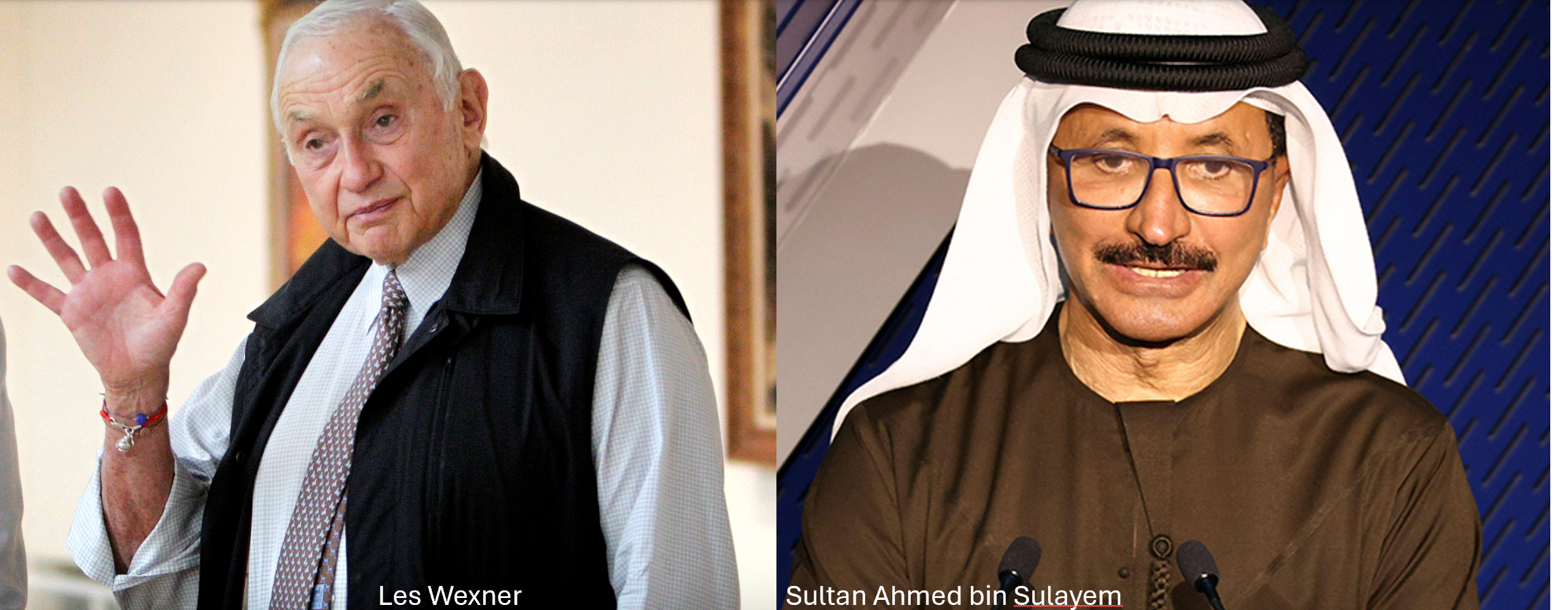
The files include imagery of girls in the company of prominent figures, such as Andrew Mountbatten-Windsor, as well as video footage depicting Epstein chasing and dancing with young women. In an email exchange, Sir Richard Branson told Jeffrey Epstein he would love to see him again “as long as you bring your harem.”
In a significant escalation this week, members of Congress pressured the DOJ to unseal the identities of two co-conspirators. The list included Wexner; Lesley Groff, Epstein’s longtime secretary; and Sultan Ahmed bin Sulayem, the Emirati billionaire and CEO of DP World. Bin Sulayem bragged in a September 2015 note about a tryst with a foreign exchange student: “She got engaged but now she back with me … The best sex I ever had amazing body.” He also apparently sent a video to Epstein at one point, to which Epstein responded: “I loved the torture video.”
Khanna bypassed the redactions in the official files by reading the names of the other alleged co-conspirators directly into the Congressional Record. These individuals include Nicola Caputo, Salvatore Nuara, Zurab Mikeladze, and Leonic Leonov.
Pardon the interruption! I just wanted to take a moment to thank all of my subscribers. A special shout-out to the paid members who help me bring this information to life every week. If you’d like to support the newsletter, you can become a paid subscriber for just $5 a month. If you can’t swing that right now, no worries! Liking, commenting, and sharing on social media helps just as much. Thanks for being here, and enjoy the rest of the read!
The Epstein Class: Why Institutional Power Protects Its Own (February 11, 2026)
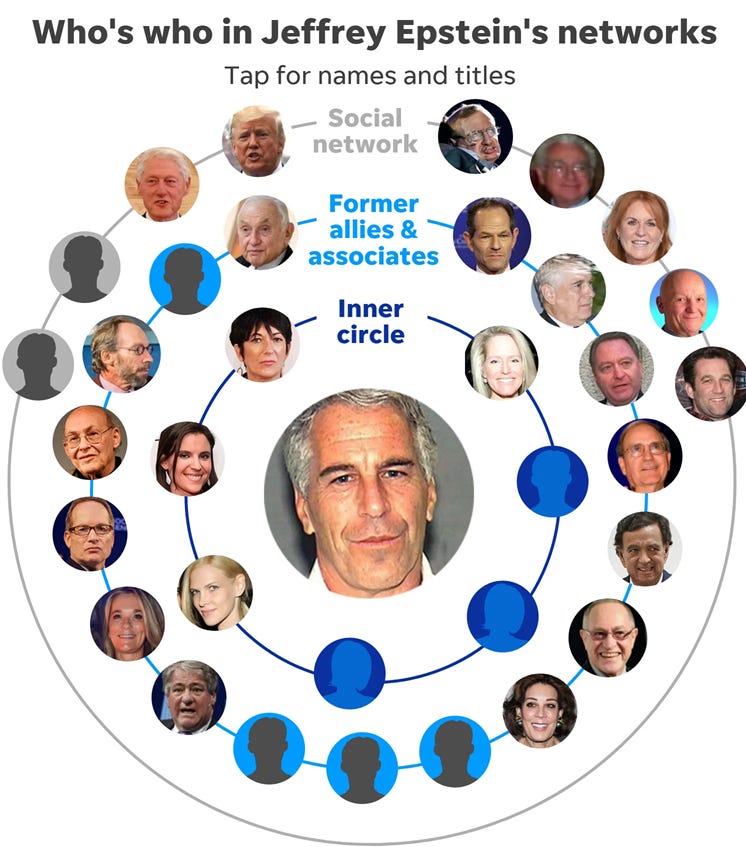
Reflecting on the legacy of the Epstein saga in July 2025, Ezra Klein told his podcast audience: “If you force me to give you my best guess, given what we know, I think this guy had a lot of very powerful friends, I think this guy was a predator and pedophile on an extraordinary scale. And I think those sides of his life were mostly separate. I don’t think there is a list of bold face names somewhere. The reason I do not think there’s a list: there have been a lot of big law firms hunting for cases here. There is a lot of money to be made in suing anyone connected to Epstein. Very, very powerful firms, say nothing of big media organizations, firms, and organizations that have the money to hire the best investigators, the best journalists, they’re just not finding it.” Klein’s take, as usual, misses the mark. Epstein cultivated a series of high-powered connections in government, law enforcement, the financial sector, academia, and news media that make it less likely that those institutions would turn on him or compel others to turn on him and his associates.
The Legal Guardrails: Elite Firms and the Architecture of Impunity
Epstein had strategically connected himself and his associates to the very firms and organizations Klein expects to expose them. In the legal sector, Epstein utilized the services of Kirkland & Ellis and maintained extensive communication with Slaughter and May, Clifford Chance, and Paul, Weiss, Rifkind, Wharton & Garrison (where Brad Karp ultimately resigned due to the relationship). Furthermore, Kathryn Ruemmler of Latham & Watkins, a former federal prosecutor and then-global co-chair of the firm’s white-collar defense practice, served as a legal advisor to Epstein when he was arrested by the Federal Bureau of Investigation (FBI) in 2019. Other key figures include Darren Indyke of DKI PLLC, who acted as a trustee and advisor on business affairs, and litigator Beth Wilkinson of Wilkinson Stekloff, who was also named in the documents. These connections were bolstered by Epstein’s close ties to high-profile attorneys Alan Dershowitz, Reid H. Weingarten, and former U.S. Solicitor General Ken Starr.
The Information War: Media Manipulation and the Sanitized Narrative
Epstein’s influence extended deeply into the news media, involving established figures such as Peter Attia of CBS, Landon Thomas Jr. of The New York Times, Steve Bannon, and Michael Wolff . In an era-defining irony, Epstein even turned to Noam Chomsky, the scholar whose work famously dissected how elite influence shapes media narratives, to help rehabilitate his public image. When Epstein sought counsel on whether to defend himself or simply ignore the mounting coverage of his crimes, Chomsky expressed sympathy, lamenting “the horrible way you are being treated in the press and public” and attributing the backlash to a “hysteria that has developed about abuse of women.” Chomsky’s final recommendation was pragmatic but stark: “It’s painful to say, but I think the best way to proceed is to ignore it.”
While he sought intellectual cover from figures like Chomsky, Epstein was simultaneously engineering a sophisticated digital defense to scrub his history. Emails reveal a multi-pronged strategy that utilized Search Engine Optimization (SEO) to prioritize flattering content while editing his Wikipedia entry to sanitize his past. This effort to “eliminate the bad” included attempts to manipulate how Google sequenced search results and a concerted push to scrub his personal data from both public and private directories to evade outside scrutiny.
Ultimately, Epstein did not merely consume media advice; he acted as an aggressive media strategist. Beyond relying on orchestrated news releases to drown out negative coverage, newly released files show him directing the flow of information with surgical precision. He frequently issued specific instructions to his network to plant details in the press, once directing a contact to “pass this on -- to the news of the world and sharon churcher at the mail in new York.”
In another exchange from 2011, Epstein wrote to publicist Peggy Siegal, asking her to contact Arianna Huffington, the founder of The Huffington Post, to discredit the allegations made by Virginia Giuffre, one of Epstein’s most vocal victims who had recently filed a sworn affidavit detailing his abuse and trafficking network. Epstein suggested that Huffington “should champion the dangers of false allegations...” Siegal responded: “If you rewrite your last email in better grammar, (and so I have a better understanding) I can cut and paste and send it to Ariana Huffington from me…”
Adding to the perception that Epstein carried significant weight in the media, powerful individuals often turned to him to manipulate or shift narratives. In the midst of the #MeToo movement, a period defined by women exposing men who used their power to harass and abuse, Epstein wrote to Joi Ito, the Japanese entrepreneur and former Director of the MIT Media Lab. In the email, Epstein claimed he had “b=en asked everday for advice etc. this morning I have Ken S=arr coming to point out how if clinton cigar lewinsky were to be outed toda= the world would be a different place.” This was a direct reference to Ken Starr, who led the investigation into President Clinton’s scandal involving Monica Lewinsky.
Further, email exchanges show, Epstein offering advice to Starr after the latter was forced to resign as Chancellor of Baylor University following the school’s mishandling of sexual assault allegations. In his response, Epstein wrote to Starr: “woody alien case the best example. a one time=allegation. not a peep of impropriety alleged afterwards” to which Starr responded, “Great ex.” Allen, the filmmaker famously known for his controversial marriage to Soon-Yi Previn, the adopted daughter of his long-time partner Mia Farrow, was also a documented associate of Epstein.
The Ivory Tower’s Patron: Eugenics, Transhumanism, and Academic Complicity
In addition to previous revelations about Epstein’s connection to academia, the recently released files reveal a deeper connection. Epstein maintained a long-standing relationship with Stephen Kosslyn, a prominent psychologist formerly of Stanford University. Epstein expressed a particular interest in Kosslyn’s work on “behavioral engineering” and continued to help organize funding for Kosslyn’s projects even after the professor departed from Stanford.
Epstein’s academic interests were often rooted in “transhumanism,” a branch of philosophy that frequently incorporates eugenicist ideas and the use of artificial intelligence. These interests led him into advanced discussions regarding the funding of gene-editing companies. Indeed, the files reveal Epstein had a lot of money invested in tech in part because he hoped to “seed the human race with his DNA by impregnating women at his vast New Mexico ranch” according to The New York Times.
The files also indicate he was preoccupied with specific racial characteristics, such as blue eyes, and viewed science as a means to manipulate human biology. Reportedly, Epstein’s initial conduit into the scientific community was John Brockman, a literary agent who represented popular science writers such as Jared Diamond and Richard Dawkins. It appears that many scientists, eager for research funding, viewed Epstein as a willing benefactor or an authority on emerging technologies.
The documents also shed light on Epstein’s personal views on race and genetics. In a 2016 email to Chomsky, the renowned linguist and activist, Epstein stated that “the test score gap amongst African Americans is well documented,” and argued that “making things better might require accepting some uncomfortable facts.” In an email conversation with Joscha Bach, a German cognitive scientist then working at MIT, who had received a £300,000 donation from Epstein, the financier implied an interest in genetically modifying Black people to make them “smarter.” In a July 2016 message, Bach wrote to Epstein: “if I understand correctly, you are suggesting [...] you might be able to make blacks smarter by changing the time for motor layer development.”
These academic ties extended beyond theoretical research into personal and professional favors. For instance, Marc Rowan, the Chief Executive Officer of Apollo Global Management, appointee to Trump’s supposed “peace board” for Gaza, and outgoing chair of the Wharton School’s Board of Advisors at the University of Pennsylvania, maintained a relationship with Epstein long after he became a registered sex offender. The two discussed financial deals and met frequently at Epstein’s home. Similarly, personal correspondence shows a level of familiarity between Epstein and his academic contacts; in one instance, Chomsky wrote that his wife, Valeria Chomsky, was “always keen on New York,” adding, “I’m really fantasizing about the Caribbean island. Have to figure out a way to work clear of endless commitments.”
Beyond the financial and scientific ties, Epstein’s academic contacts illustrate a stark contrast between those who facilitated his influence and those who resisted it. His long-term attorney, and Harvard University professor, Alan Dershowitz, supported Epstein until the very end. The files reveal a collaborative effort between Epstein and Dershowitz to undermine John Mearsheimer of University of Chicago, and Harvard University professor Stephen Walt’s research exposing the influence of the Israel lobby in the United States. Despite this professional alliance, the documents show a different side of the relationship, with Epstein and filmmaker Woody Allen mocking Dershowitz in private.
Conversely, the records highlight individuals who were quick to admonish colleagues for maintaining ties with Epstein. Professors such as Joseph Chaney and Norman Finkelstein represent a faction within academia that resisted Epstein’s social integration. In one notable instance, a colleague forwarded an email to Finkelstein that Chaney had written castigating that same colleague for staying in contact with Epstein. Finkelstein’s response was characteristically blunt: “My guess is, if Epstein put your daughter at age 15 in such a position, you wouldn’t publicly describe him as a ‘friend’ and person of ‘integrity.’ In fact, I would hope that you’d promptly throttle both Epstein and Dershowitz.”
The High-Finance Connection: Money Laundering, Insider Trading, and the Global Elite
In addition to academics, Epstein maintained a sprawling network of high-profile connections spanning finance, technology, and politics, including figures such as Bill Gates, Les Wexner, Elon Musk, Sergey Brin, Peter Thiel, Reid Hoffman, and Larry Summers.
The files provide more information regarding Epstein’s relationships with the financial elite. For example, documents regarding former Barclays CEO Jes Staley reveal that Epstein utilized contacts in academia to assist Staley’s daughter with college admissions. The files also disclose a rape allegation against Staley. Furthermore, Epstein maintained a close relationship with the World Economic Forum President, Børge Brende. Records indicate the two dined three times between 2018 and 2019 and frequently exchanged texts and emails. Although Brende denied having any contact with Epstein in November 2025, he has since admitted to knowing him.
JPMorgan CEO Jamie Dimon claims that he does not remember any contact with Epstein. However, an investigation by The New York Times Magazine found that during the period Epstein was regularly abusing teenage girls and young women, senior executives repeatedly ignored staff concerns. These concerns included Epstein opening accounts for young women and his pattern of withdrawing tens of thousands of dollars in cash nearly every month, a behavior employees were specifically trained to identify as a potential indicator of sex trafficking.
Observers and investigators contend that Epstein’s connections to the financial elite may also have been motivated by opportunities for insider trading. Epstein was investigated in 1981 as part of an insider trading scandal at Bear Stearns. Around that same time, he worked at Towers Financial with Steven J. Hoffenberg, often described as Epstein’s mentor. When Towers Financial collapsed as a Ponzi scheme, Hoffenberg alleged that Epstein helped orchestrate it.
Similar speculation surrounds billionaire Leon Black, who has faced intense public criticism for his deep financial ties to the financier. For instance, Epstein arranged a $25 million art holding for Black. While some believe Black paid Epstein for insider information, this has not been corroborated. Black did, however, make a $158 million payment to Epstein. The files show their relationship eventually became rocky, with Epstein demanding “the usual 40 million per year,” for tax-and-estate-planning services between 2015 and 2016. As the co-founder of the private equity behemoth Apollo Global Management (Apollo), which manages approximately $785 billion in assets, Black’s ties to Epstein have carried significant professional and legal weight. He was shamed out of Apollo in 2021 due to his affiliation with Epstein.
In 2023, it was revealed that Black agreed to pay $62.5 million to the U.S. Virgin Islands to resolve potential claims and protect himself from future prosecution regarding crimes related to Epstein’s sex-trafficking ring. Black was sued in 2023 for the alleged 2002 rape of a 16-year-old girl with autism and a rare form of Down Syndrome at Epstein’s Manhattan residence. The recent release of these files provides further alleged gruesome details about that allegation.
Other records indicate how eager financial elites were to collaborate with Epstein. For example, after Colom left the French Government to work for the Edmond de Rothschild private banking group, he appeared eager to please Epstein, offering to put him in touch with ambassadors, a member of the European Parliament, “an Indian rising star of politics” and “the Russian vice-minister of Economy.” Currently, the UK investigation remains the primary opportunity to determine if these insider trading claims are legally warranted.
In 2011, Landon Thomas, then of the New York Times, appeared to treat Epstein’s access to sensitive financial information as a matter of fact. He reached out to Epstein asking, “Do you know anyone/fund out there who made an early investment call on the middle east going to hell and loaded up on oil futures or some such to take advantage?” Epstein’s response was brief: “i know a few,, i;ll ask.” This email exchange was sent to another redacted individual.
In response to the files, in 2026, the UK government has opened an investigation into allegations that Andrew Mountbatten-Windsor participated in some form of insider trading with Epstein.
Bi-Partisan Brokering: The Political Architecture of Influence
Epstein maintained deep and influential ties to both the Democratic and Republican parties, often currying favor through strategic financial contributions. Records indicate he communicated with and donated to prominent Democrats throughout the 1990s and early 2000s, including former U.S. Senator and Secretary of State John Kerry, former Senate Majority Leader George Mitchell, and former New Mexico Governor Bill Richardson.
His long-time associate and convicted co-conspirator, Ghislaine Maxwell, served as an adviser for the Clinton Global Initiative (CGI) and arranged for $1 million in funding for the organization. Internal emails confirm that Epstein was aware of this arrangement, though the original source of those funds remains undisclosed.
Epstein’s political influence appeared to extend into the legislative process as well. Stacey Plaskett, the United States Virgin Islands’ delegate to the U.S. House of Representatives, famously exchanged text messages with Epstein during a high-profile congressional hearing involving Michael Cohen. The files reveal that Plaskett reached out to Epstein to facilitate an introduction to Senate Minority Leader Chuck Schumer, a leader within her own party. At the time, Plaskett was lobbying for disaster relief and seemingly had to rely on a private individual with no official party role to bridge the gap with the leadership of the upper chamber.
Epstein also had connections to the Republican Party such as former governor of US Virgin Islands Kenneth Mapp (who ran as an independent). Perhaps Epstein’s most scrutinized political connection was his long-standing social relationship with Donald Trump. The files suggest they remained in contact during Trump’s first administration, a claim Trump has vehemently denied, arguing the relationship ended a decade prior. However, in late December 2016, Epstein wrote to a friend stating that he was “in palm with all the trump boys.” While the exact meaning of that phrase remains unclear, Epstein’s brother has independently stated that Epstein continued to speak with Trump even after he was elected President.
Complicating matters, Trump has frequently asserted that he knew nothing of Epstein’s sex crimes, despite once famously remarking that “Jeffrey likes them young.” However, a former Palm Beach, Florida, police chief who investigated Epstein in the mid-2000s told the FBI that he received a call from Trump at the time. According to a 2019 FBI interview account, the former chief claimed Trump said, “thank goodness you’re stopping him, everyone has known he’s been doing this.” This statement directly contradicts Trump’s repeated claims that he was unaware of Epstein’s predilection for young girls during the years they associated with one another.
Last week, we discussed how U.S. Secretary of Commerce Howard Lutnick is mentioned extensively throughout the Epstein files, yet he is hardly the only member of the Trump administration to appear in the documents. Joining Lutnick is the Secretary of the Navy, John Phelan, whose name appears on Epstein’s flight logs as early as 2006. While many names in the records remain redacted, one that is clearly visible is Brunel.
In addition to Lutnick and Phelan, Ben Black, the Chief Executive Officer of the U.S. International Development Finance Corporation (DFC), appears in the files in the context of attempting to commission artwork through Epstein. Ben Black’s father is billionaire Leon Black.
The Third Rail: Intelligence Assets and Shadow Diplomacy
The investigative files further detail what many consider the “third rail” of the Epstein saga: his alleged connections to the intelligence community. In addition to previously documented contacts with the Central Intelligence Agency (CIA), the files reveal that Epstein messaged with the former director of the CIA, William J. Burns. The records also contain claims from a Federal Bureau of Investigation (FBI) informant alleging that Epstein acted as an operative for the Mossad (Israel’s national intelligence agency). In the 2011 records include an email from an unknown individual seeking assistance to access frozen Libyan assets, with claims that British and Israeli intelligence were interested in providing support. In another exchange, Ehud Barak, the former Prime Minister of Israel and former Minister of Defense, discusses Israeli demographic management. Following the release of these files, the current Prime Minister of Israel, Benjamin Netanyahu, chastised Barak’s behavior on the social media platform X.
Beyond verified contacts, the files contain a significant volume of speculative claims. Adding to the intrigue is behavior that observers characterize as spy-like, including Epstein’s use of multiple email aliases (including “the invisible man”), passports containing alternate identities, and hidden cameras in his residence. Furthermore, the files mention Robert Maxwell, the late British media tycoon and father of Ghislaine Maxwell, who was long suspected to be an Israeli intelligence asset before his mysterious death. In one email, Epstein writes that Robert Maxwell “was “passed away”; many readers have interpreted this specific phrasing as a cryptic confirmation of the theory that Maxwell was killed during an intelligence operation.
Other interpretations of the communications suggest Epstein attempted to use intelligence to advise Narendra Modi, the Prime Minister of India, and to share data with Steve Bannon concerning Chinese dissidents. However, in these instances, investigators note that the evidence remains largely circumstantial.
Nonetheless, Epstein often communicated as if he possessed high-level “insider” knowledge. For example, he warned an associate that the Nigerian-Lebanese billionaire and Ambassador of Saint Lucia to UNESCO, Gilbert Chagoury, was facing an imminent indictment. In some cases, powerful people believed his “intelligence.” For example, Epstein was in regular contact with Baroness Ariane de Rothschild, the Chief Executive Officer (CEO) of the Edmond de Rothschild Group. Epstein extended various offers of professional and personal assistance to the Baroness. In one instance, he provided specific security advice regarding a planned trip to Nicaragua—advice that her security team reportedly implemented.
The Final Act: Contradictions and Anomalies in the Official Record
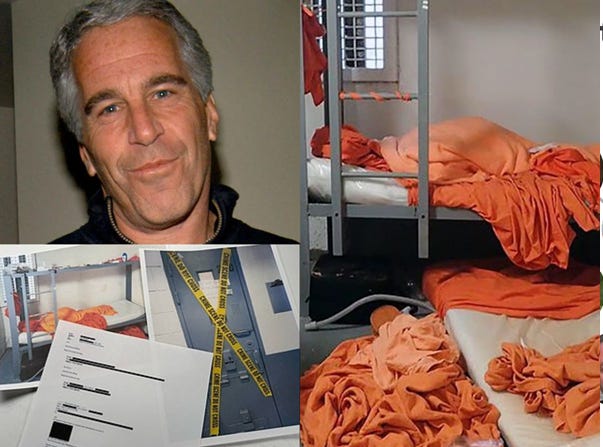
Epstein’s perceived influence and vast network of powerful connections have fueled persistent skepticism surrounding his death. While the official ruling remains suicide, investigative files have frequently contradicted established accounts rather than clarifying them. From the outset, authorities struggled to provide a consistent explanation for why a high-profile inmate on suicide watch was left unmonitored by both guards and cameras.
These inconsistencies deepened when the latest files revealed that a “decoy body“ was allegedly fashioned under a sheet to distract the media during the removal of his remains, and that the prosecutor’s death notice was dated a day prior to Epstein’s death. However, many believe the latter was a clerical error.
Furthermore, CBS reports that investigators claim the noose Epstein used was never recovered. This remains highly suspect given that Epstein was alone in a locked cell at the time of the incident. This lack of physical evidence is compounded by security footage showing an unexplained orange dot moving toward his cell via a stairwell during the two-hour window of his death. Weeks prior to his death, Epstein was found unconscious. At the time officials, labeled it a suicide attempt, but Epstein maintained that he had been assaulted by another inmate.
Conclusion
The parallels between the Credit Mobilier scandal and the modern Epstein revelations are as unmistakable as they are unsettling. In the 1870s, the American public watched as a web of financial bribery was exposed, only for the “logic” of the era to shield the very lawmakers who enabled the corruption. Today, the United States faces a similar crossroads. The Epstein Class, a sprawling network of legal, financial, academic, and political elites, has effectively functioned as a protective layer, ensuring that while the central figure is gone, the machinery that facilitated his crimes remains largely untouched.
To allow this saga to dissolve into partisan bickering or redacted silence would be to repeat the failures of the first Gilded Age. Accountability in a functioning democracy cannot be selective; it must apply to the “untouchable” titans of industry and government just as rigorously as it does to the individual. If the Epstein files serve only as a sensationalist footnote rather than a catalyst for systemic reform, we risk solidifying a era where concentrated wealth does not just catalyze corruption, but successfully erases the possibility of justice.
Epstein in the Shadows: Incomplete Truths and the High Cost of Official Secrecy (February 18, 2026)
Recently, social media was flooded with images purportedly showing New York City Mayor Zohran Mamdani as a child alongside his mother, filmmaker Mira Nair, in the company of deceased sex offender Jeffrey Epstein and his co-conspirator Ghislaine Maxwell. In reality, these images were sophisticated deepfakes, likely engineered as a character assassination attempt against Mamdani.
This targeted attempt to link Mamdani to the Epstein circle highlights the very type of conspiratorial fervor that experts argue is exacerbated by government gatekeeping. Dr. Kathryn Olmsted of the University of California, Davis, observes that conspiracy-minded thinking tends to flourish as governments become increasingly bigger and more secretive.
The handling of the ‘Epstein Files’ supports Olmsted’s view, as the Trump administration has worked to restrict what information about Epstein reaches the public. During the 2024 campaign, Donald Trump advocated for the full release of these records. Once President, his Attorney General, Pam Bondi, even claimed to possess a list of known co-conspirators. However, months later, Bondi, Federal Bureau of Investigation (FBI) Director Kash Patel, and Deputy Director Dan Bongino asserted that the files contained no actionable evidence for prosecution. When Congress appeared ready to force the release of the Department of Justice (DOJ) files on Epstein through the Epstein Files Transparency Act, Trump dismissed the Epstein scandal as a Democrat-led “hoax“ and reportedly pressured GOP lawmakers to oppose the legislation. Marjorie Taylor Greene, then a Representative from Georgia, claims Trump told her “his friends” were in danger if the files were released.
Following the enactment of the Epstein Files Transparency Act, which mandated the public disclosure of all DOJ records related to the case, the resulting rollout has faced intense scrutiny. While the Act allows for narrow redactions to protect survivor privacy or active investigations, critics argue the process has been applied inconsistently; in several documented instances, the identities of survivors were left exposed while the names of high-profile potential co-conspirators remained shielded from public view.
Representatives Ro Khanna and Thomas Massie successfully led a bipartisan charge to “un-redact” some of the names of ten alleged co-conspirators through a mix of pressuring the DOJ and reading the names into the congressional record. However, the one convicted co-conspirator Ghislaine Maxwell, claims there are 25 others who received deals with the federal government to avoid prosecution. The DOJ’s decision to redact these ten co-conspirators demonstrates at best a violation of the law and disregard for transparency, and at worst, an effort to protect known co-conspirators. This secrecy is particularly galling given that nude images of victims, which were legally permitted to be redacted, were released by the DOJ.
The Architecture of Secrecy

Beyond the immediate legal battles, Ira E. Hyman Jr., a Professor of Psychology at Western Washington University, argues in Psychology Today that the “slow and incomplete release of information” regarding Epstein is actively fueling public belief in baseless conspiracy theories. A functional democracy is predicated on transparency; while the public would be better positioned to draw accurate conclusions if the files were released in their entirety, the Trump Administration has instead opted for a strictly selective release.
By the government’s own estimates, over three million files remain withheld or heavily obscured. A Channel 4 investigation concluded that a mere 2% of the documents have been made public. Compounding this, significant records held by the Epstein estate and various financial institutions remain hidden, while the government has occasionally posted and then abruptly retracted files. Consequently, these conspiracy theories may be less a product of public imagination and more a direct result of a secretive government providing a curated, rather than comprehensive, account of the facts.
The lack of transparency is further exacerbated by the fact that one of the most powerful figures at the center of the Epstein narrative, President Donald Trump, remains largely redacted despite frequent mentions. According to New York Times, President Trump is referenced 38,000 times in the released files; however, Representative Jamie Raskin notes that Trump’s name appears over a million times in the unredacted, unreleased versions. Furthermore, unlike other nations that have utilized these disclosures to launch inquiries into financial and sexual crimes, the U.S. government, led by Trump, has not engaged in any formal investigation of the public officials or institutions implicated in the files.
Ultimately, a critical analysis of the files, one that prioritizes evidence over speculation, is the most effective path forward. Lawmakers like Representative Thomas Massie have suggested that as the 2026 election approaches, more Republican Party officials may defect and support a full release in an effort to claim the mantle of public transparency. However, achieving true accountability requires the public to maintain pressure on legislators rather than succumbing to fatigue or dismissing all evidentiary discussions as mere “conspiracy.” What follows are some of the latest findings uncovered within the Epstein files.
Breeding Grounds: The Eugenics Obsession at Zorro Ranch

“New Mexico approves truth commission on alleged Jeffrey Epstein ranch abuse,” read a The Guardian headline on February 17, 2026. The day prior, New Mexico officially approved a commission to investigate years of alleged abuse at Epstein’s estate outside Santa Fe, known as Zorro Ranch. This legislative action followed intense public pressure sparked by revelations in the recently released Epstein files. The commission aims to address the testimonies of multiple women and girls who reported being sexually abused on the sprawling 10,000-acre (4,000-hectare) property, which served as a secluded hub for Epstein’s operations for decades.
In 2019, The Guardian reported on a disturbing ambition, “Epstein reportedly hoped to develop a super-race of humans with his DNA.” This coverage expanded on earlier reporting from The New York Times, which detailed Epstein’s plan to “seed the human race” by impregnating up to 20 women at a time at his ranch. Epstein was reportedly motivated in part by a desire to extend his life. Recent revelations from the unsealed files confirm these reports, linking his actions to a deep-seated belief in eugenics, a discredited social philosophy that advocates for ‘improving’ the human gene pool through selective breeding and the systematic exclusion of groups deemed inferior.
Many online observers have described the New Mexico ranch as a “baby farm,” which implies that infants were being tested there. While there have been allegations of sexual abuse on the property, no reporting or evidence within the files has proven the existence of a baby farm. Nevertheless, the documents do include specific details that are drawing significant attention to the story. For example, the files include a survivor who claimed she was used by Epstein as a “human incubator” in 2002. In 2013, another woman wrote via email to remind Epstein that he made “threats” toward her and stated, “You offered to buy my baby six months into our relationship.” Another email sent in 2019 to a conservative radio host in New Mexico read, “Did you know somewhere in the hills outside the Zorro, two foreign girls were buried on orders of Jeffrey and Madam G? Both died by strangulation during rough, fetish sex.” The sender, using an encrypted email address, promised to send a USB with videos confirming the claims, but it is not known if the USB was sent.
The document releases also include a series of email exchanges from September 2011 that journalists attribute to Sarah Ferguson, Duchess of York, congratulating Epstein on purportedly having a “baby boy.” One message reads: “Don’t know if you are still on this bbm [BlackBerry Messenger] but heard from The Duke that you have had a baby boy.” In another email, the sender, presumably Ferguson, wrote: “Even though you never kept in touch, I still am here with love, friendship and congratualtions [sic] on your baby boy. Sarah xx.” Despite these messages, Epstein is not known to have had any children. Indeed, the sender, seemingly the Duchess of York, appears surprised by the news, writing: “You have disappeared. I did not even know you were having a baby.” Further complicating this narrative is a February 2012 email sent to Epstein from a redacted address which states: “Baby boy due on March 15th.” Epstein’s brother denied that his brother had a child.
Regardless of whether or not he fathered a child, the files shed light on how Epstein’s obsession with gene editing led him to recruit so-called “code breakers” from the National Security Agency (NSA). This is not too surprising as I have previously noted that the files illustrate that Epstein had contact with high-level officials from U.S. intelligence agencies including the Central Intelligence Agency (CIA) and National Security Agency (NSA). Drop Site News reports that Epstein recruited gene-code breakers - scientists and technologists that decipher or manipulate the genetic code, enabling the editing, rewriting, or expansion of DNA instructions - from the NSA for over a decade. Epstein reached out to Daniel Dubno, a CBS News producer who previously worked with The Defense Advanced Research Projects Agency (DARPA) and the Department of Homeland Security (DHS). He also reached out to computing pioneer Danny Hillis asking “i am looking for nsa quality code theorist.” Eventually, Epstein reportedly leveraged his friendship with then-White House Counsel Kathryn Ruemmler to seek help finding NSA codebreakers. Their relationship included thousands of emails where Ruemmler called him “Uncle Jeffrey.” This week, the exposure of these ties led to her high-profile departure from Goldman Sachs. Epstein’s connections with people in the intelligence community went beyond the U.S.
The Intelligence Nexus: Assets, Informants, and Mossad
“Israeli intelligence sources reject claims Jeffrey Epstein was Mossad [The Institute for Intelligence and Special Operations] operative following document releases,” read a February 2026 Fox News headline. The Israeli government seemingly felt compelled to address the matter after unsealed files revealed that both an FBI informant and a confidential human source had explicitly identified Epstein as an asset of Israeli intelligence (possibly Mossad, the national intelligence agency of the State of Israel).
The documents further corroborate these ties, detailing Epstein’s extensive connections to Israeli intelligence circles and former Prime Minister Ehud Barak. Most recently, the files disclosed how Epstein brokered a series of high-level deals involving Barak, Nigerian President Goodluck Jonathan, and Sultan Ahmed bin Sulayem. Following revelations that he was one of the ten co-conspirators linked to Epstein, and maintained a long-standing relationship with him, Sulayem resigned from his position at DP World on February 13, 2026.
Inner Circles: The Administration and the Epstein Network
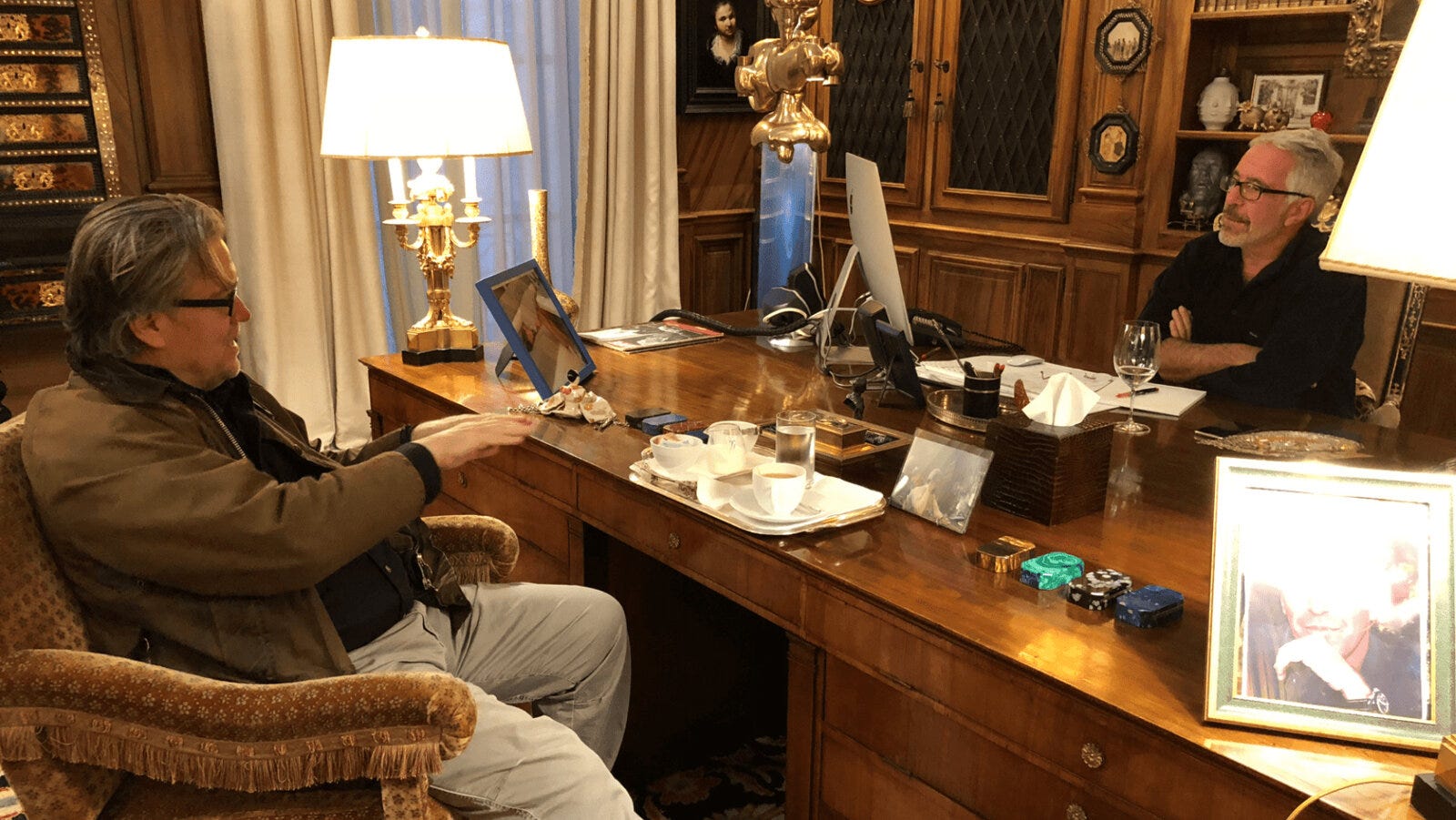
There are indications in the files that Epstein’s connections to Trump’s inner circle, if not Trump himself, persisted into Trump’s first term. One of those connections was Tom Barrack, who currently serves as the U.S. Ambassador to Turkey and Special Envoy to Syria. During Trump’s first term, Barrack was a top fundraiser, key advisor, and Chairman of the 2017 Presidential Inaugural Committee. Barrack joins other administration officials discussed in previous posts as having associations with Epstein, such as former Secretary of Labor Alex Acosta and Commerce Secretary Howard Lutnick.
The relationship with another known associate from Trump’s first term has also become clearer. Epstein maintained a surprisingly close relationship with Steve Bannon, the former White House Chief Strategist during Trump’s first term. Files indicate Epstein advised Bannon on how to structure his podcast to build a media empire rather than a non-governmental organization (NGO), which would have invited stricter financial scrutiny. In addition to leveraging his relationship with Canadian-American billionaire Mortimer Zuckerman to influence the New York Daily News’s coverage of allegations following his 2008 conviction for soliciting a minor, Epstein worked with Bannon to repair his public image by positioning him as a figure who could expose the secrets of the global “elite.”
Their correspondence suggests they discussed Trump’s apprehension regarding Bannon speaking to Epstein, with Epstein texting Bannon: “Now you can understand why Trump wakes up in the middle of the night sweating when he hears you and I are friends.”
In a text message exchange, Bannon and Epstein bemoaned how Trump had lost the midterm elections to the Democrats. Bannon stated that the White House had “zero plan to punch back.” “He is really borderline,” Epstein responded. “Not sure what he may do.” Bannon replied, “I think it’s beyond borderline — 25 amendment.” The 25th Amendment, which is a constitutional mechanism used to remove a president from office who is deemed unfit to serve. In 2017, Michael Wolff, who also close to Epstein, reported that Bannon had once warned Trump that the 25th Amendment was the actual threat to his presidency.
The Ivy League Contagion: Academic Collateral Damage

The ripples of the Epstein scandal have been particularly destructive within academia. Academia’s connections to Epstein have been discussed for years including Larry Summers (who stepped down from some roles at Harvard University and OpenAI as a result), Noam Chomsky, and Marvin Minsky. Minsky, a renowned MIT AI scientist, had connections to Epstein, including accepting research funding and visiting Epstein’s private island. Minsky was also implicated in accusations by Virginia Roberts Giuffre, who claimed she was directed by Epstein to have sex with him, allegations denied by Minsky’s widow.
In the weeks following the release of the largest trove of files, several prominent professors have faced severe professional consequences. At the University of California, Los Angeles (UCLA), officials removed the media expert profile of Mark Tramo, an associate adjunct professor of neurology, following a petition for his removal. Meanwhile, David Ross resigned as department chair at the School of Visual Arts in Manhattan after records showed he responded enthusiastically to Epstein’s proposal for an art exhibit featuring underage models. At Yale University, computer science professor David Gelernter was removed from the classroom pending a review of his correspondence with Epstein. Columbia University recently severed ties with Dr. Thomas Magnani and stripped Dr. Letty Moss-Salentijn of her administrative duties. The disciplinary actions followed the release of documents revealing that both dental college faculty members bypassed standard admissions protocols to facilitate the enrollment of Jeffrey Epstein’s girlfriend.
Similarly, Duke University closed three research centers, including the Center for Advanced Hindsight. While Duke University officials claimed the closure was unrelated to Director Dan Ariely’s hundreds of mentions in the Epstein files, the timing coincided with Ariely’s public defense of his relationship with the financier. University of Arizona cancelled its “Science of Consciousness” conference after anesthesiologist Stuart Hameroff admitted to accepting funding from Epstein.
The fallout even reached university boardrooms. Brad Karp, a trustee at Union College, resigned from his role and his position at the law firm Paul, Weiss, Rifkind, Wharton & Garrison. Additionally, Thomas Pritzker, cousin of Illinois Governor J. B. Pritzker, a trustee at the University of Chicago, and Francine LeFrak, a trustee at Barnard College, have seen their ties to Epstein come under intense scrutiny.
Other academic leaders have attempted to get ahead of the controversy. Leon Botstein, the President of Bard College, wrote to his campus to clarify that his interactions with Epstein were strictly for fundraising purposes, describing Epstein as a “skilled manipulator.”
The Mechanics of Exploitation: Evidence of the Empire
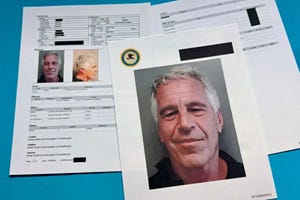
What is well known is that Epstein engaged in trafficking girls. There have been allegations from survivors who claimed that they were as young as 11 years old. In the DOJ’s files, investigators concluded that Epstein knowingly sought out minors for sexual abuse and trafficking. There are videos which show Epstein chasing young girls around a kitchen, and there are images which show Epstein in the company of minors.
The files add more depth and questions to Epstein’s predictions. For example, email communications show Epstein instructing a 14-year-old girl to send him pictures of herself: “ he photos should not be porn but should be sexy, do you watch porn? &n=sp; [suspicious link removed] for example. &nb=p; you want to be free without being porn, but=laugh , have fun,” but reminds her “you are going to be 22. not =4 years old.”
There is also a statement from a lawyer who claims that a victim, who was at a prepubescent age, was sexually assaulted by someone who allegedly knew Maxwell and Epstein and may have been trafficked by them. The lawyer provided a redacted photo, describing it as follows: “The photo shows a girl, her face visible, who looks prepubescent with medium length dark hair. Several Caucasian men are holding the girl’s legs spread open…[the rest of the statement is quite graphic and can be found on page 7 at the bottom for those who want to read it].”
In addition to the crimes, there is further evidence detailing how Epstein constructed his sex trafficking empire. The files indicate that Epstein leveraged his ties to model Naomi Campbell - a prominent figure for Victoria’s Secret, whose chief executive at the time was another alleged co-conspirator, Les Wexner - to attract young girls aspiring to be models. It was previously known that Epstein would invite young women to parties, promising to introduce them to high-powered industry connections; however, one girl claimed the only people present besides the girls were reportedly Epstein and Trump. Epstein also aggressively commanded these women, telling one individual of unknown age: “its time you start an education. 1. do not say FUCK to anyone except in bed. especailly not at the table. 2. you are 22, --only ask questions of men. they are not really intersted in your opinions until you are 30. and then only marginally, 3. I am very respectful that you have not been taught 21 century science. , so you can be forgiven in beliveing the world is flat. or the sun relvolves around the earth.”
The Transparency Antidote: A Call for Accountability
This week, in an attempt to get members of Congress on the record about the Epstein files, Drop Site News deployed a reporter to Capitol Hill. Much to their chagrin, members of Congress either spoke in vague terms of wanting “justice” or “accountability” without naming specific processes or guilty parties, or they pretended that they had not had a chance to review the files.
Either way, it illustrates the ways in which the political class in the U.S. seems poised to take a pat on the back for releasing the files, but avoid doing what Norway, Poland, the United Kingdom, France, Latvia, Lithuania, Slovakia, and Sweden have done.
For their part, Democrats have responded by introducing “Virginia’s Law,” named after Epstein survivor Virginia Giuffre. This landmark legislation seeks to eliminate the statute of limitations and jurisdictional restrictions in civil sexual abuse cases. However, much more needs to be done.
As long as the full record remains a curated subset of the truth, the vacuum will continue to be filled by sophisticated deepfakes and digital assassinations. True transparency is the only antidote to the conspiratorial fervor that currently thrives in the shadows of government gatekeeping.
The Vaulted Gates: Intelligence, Impunity, and the Architecture of the Epstein Class (March 2026)
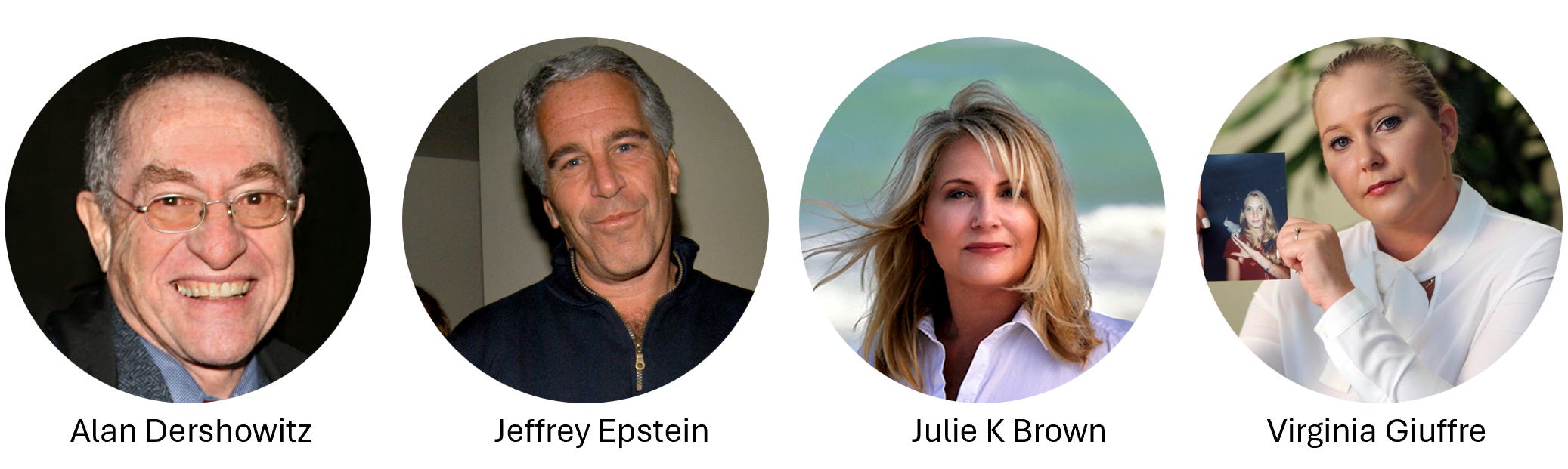
“Don’t Reward Fake News,” read an “Open Letter to the Pulitzer Prize Committee“ lambasting Julie K. Brown’s reporting on the deceased financier and registered sex offender Jeffrey Epstein. The letter claimed that Brown, the leading journalist on the Epstein saga for decades, amplified fake news stories, including one about Epstein accuser Virginia Roberts Giuffre, whom the letter claimed had “a long and documented history of lying about sexual and other encounters with famous people.” Since 2025, the 2019 letter and its claims have been largely discredited by the release of the Epstein files, which substantiate Brown’s reporting and the allegations made by the late Giuffre. Because a significant portion of the Department of Justice’s (DOJ) records on Epstein, as well as financial documents, estate records, and a substantial volume of alleged digital data concealed prior to Epstein’s 2019 arrest, remain unreleased or heavily redacted, it is impossible to verify the accuracy of the author’s claim that all other allegations are false.
The letter in question was written by Alan Dershowitz, a lawyer and Harvard professor to whom Giuffre previously claimed she had been trafficked by Epstein. While Dershowitz denies these allegations, Giuffre later stated that the claim “may” have been a “mistake.” Nonetheless, the close relationship between Dershowitz and Epstein is well documented throughout the files. Both are identified by a Confidential Human Source (CHS) in the files as an intelligence asset for Israel. The files show a lengthy and close relationship between Epstein and Dershowitz. Dershowitz has claimed that Epstein was just a friend and client, but documents reveal it was much more. For example, he collaborated with Epstein to undermine the credibility of a study by political scientists Stephen Walt of Harvard and John Mearsheimer of the University of Chicago. That 2006 study represented one of the earliest forms of scholarship exposing the influence of the Israeli lobby within the United States.
Dershowitz is among a cohort of public figures who initially dismissed the Epstein allegations as baseless, only to later appear within the unsealed files. Similarly, Donald Trump, who lawmakers assert is referenced extensively in the documents, previously labeled the scandal a ‘hoax.’ Conservative commentator David Brooks also dismissed the Epstein saga as a “stupid story” before his own ties to Epstein surfaced. Much like Noam Chomsky, Commerce Secretary Howard Lutnick, and Elon Musk, Dershowitz is one of many who characterized his relationship as merely professional or casual, only for the records to suggest a more significant connection.
The Protected Class: How Media and Law Enforcement Vaulted the Gates
Commentators skeptical of a broader Epstein conspiracy often argue that if such a network of elites existed, a free society with a vibrant press would have exposed it long ago. This dismissal, however, ignores the reality that numerous survivors did come forward, only to be systematically silenced. Even when legal action was taken, it resulted in a notorious “sweetheart deal“ that provided Epstein a remarkably lenient sentence despite clear evidence of sex trafficking.
Alexander Acosta, the former U.S. Attorney who brokered the non-prosecution agreement, reportedly told journalist Vicky Ward in 2019 that he gave Epstein the deal after he was told Epstein “belonged to intelligence” and was “above his pay grade.” In 2025, Acosta retracted those assertions, ultimately stating he had no recollection of such a conversation. However, the files reveal that a CHS told the FBI that Dershowitz is the one who told Acosta that Epstein was intelligence. The file reads “CHS remembered Dershowitz tell Alex Ocasta (U.S. Attorney of Southern District of Florida at the time) that Epstein belonged to both U.S. and allied intelligence services.” The same CHS reported that Epstein was trained by Israeli Intelligence Mossad under Israeli Prime Minister and Defense Minister Ehud Barak, and Dershowitz was the middle person between Mossad and Epstein.
Rather than investigate such allegations, too many in news media often provided cover rather than scrutiny for Epstein and his associates. For example, Vanity Fair removed allegations involving underage girls from a 2003 profile. Similarly, an ABC News reporter accused the network of burying a 2015 interview with an Epstein accuser, a claim the network denies. A New York Times reporter accepted gifts from Epstein and failed to report on his interest in minors. As journalist Alan Macleod noted outlets like HuffPost, Forbes, National Review, and even The New York Times ran puff pieces on Epstein long after serious allegations were public. This protective layer was reinforced by Epstein’s personal relationships with influential media figures such as Michael Wolff, Steve Bannon, and Landon Thomas Jr. Indeed, the relationships were so close they occasionally bordered on criminality. For example, email communications reveal that Wolff sought an advance copy of James Patterson’s book about Epstein—even signing a non-disclosure agreement to obtain it—only to then forward a copy of the manuscript directly to Epstein himself.
Some in the press continue to offer cover for Epstein’s associates. This ranges from liberal outlets like The New York Times running a February 2026 op-ed titled “The Epstein Files Should Never Have Been Released,” to Fox News attempting to discredit survivors with headlines like “Ro Khanna’s State of the Union guest recruited over 20 underage girls for Epstein.” Indeed, Media Matters noted that Fox News has dedicated significantly less airtime to the story than its competitors. From the latest document release on January 30 through February 17, 2026, MSNBC made 3,321 “Epstein” mentions, while CNN made approximately 2,304. Even Newsmax, a right-wing competitor, mentioned Epstein 1,464 times in that period, logging over 1,000 more mentions than Fox News and even calling out the network for burying the story.
Even alternative media figures are downplaying the revelations. Alex Gutentag and Michael Shellenberger recently concluded that “the totality of available evidence does not support the picture of a government-backed sex blackmail operation.” Not only is this conclusion unsupported by the released files, but it is also premature; we still do not have access to the full record. Drawing a definitive conclusion based on incomplete evidence is a fundamental failure of investigative logic.
Other news outlets appear to be providing cover through distraction. A growing number of reports have propagated the theory that if Epstein was indeed part of an intelligence operation, he was working for Russia. However, recent disclosures suggest this focus may serve as a distraction from more substantiated ties to Western and allied intelligence services. As noted in my previous posts, Epstein’s relationships with U.S. intelligence are well-documented. Recent reporting from Drop Site News further reveals his ties to the Israeli government. Furthermore, a CHS claimed that Epstein was Israeli intelligence. Most strikingly, investigative reports published this month revealed that the Israeli government directly managed security and access at Epstein’s Manhattan apartment building where former Israeli Prime Minister Barak frequently stayed. Emails show that the Israeli Government installed sophisticated surveillance equipment and alarms at the residence, with Epstein’s explicit permission to make the necessary structural modifications. Despite such concrete evidence of operational cooperation with Israeli state security, a significant portion of the media continues to pursue the narrative of Russian involvement, overlooking a documented trail that leads directly to the heart of allied intelligence networks.
While outlets like The Wall Street Journal, CBS, Drop Site News, Breaking Points, The Miami Herald, and NPR have recently produced valuable reporting on the Epstein saga, that work is increasingly under threat. David Ellison, son of Trump ally and Oracle founder Larry Ellison, recently acquired CBS (via Paramount Global) and installed Bari Weiss as Editor-in-Chief. This week, the Ellisons’ Paramount Skydance emerged as the winning bidder for Warner Bros. Discovery, placing CNN under their control as well. Much like the coverage at CBS, there are concerns that deep reporting on Epstein at CNN will now avoid questions of Trump’s involvement. Furthermore, after a Trump-backed consortium including Oracle gained control of TikTok, users reported the platform was censoring discussions of Epstein. Meanwhile, YouTube has been demonetizing Epstein-related content. To bypass these corporate barriers and “tech lords,” it is now critical to become a paid subscriber to independent outlets that produce courageous, unfiltered content.
Pardon the interruption! I just wanted to take a moment to thank all of my subscribers. A special shout-out to the paid members who help me bring this information to life every week. If you’d like to support the newsletter, you can become a paid subscriber for just $5 a month. If you can’t swing that right now, no worries! Liking, commenting, and sharing on social media helps just as much. Thanks for being here, and enjoy the rest of the read!
Transparency Denied: The Battle Over Redacted Files and Political Gatekeeping
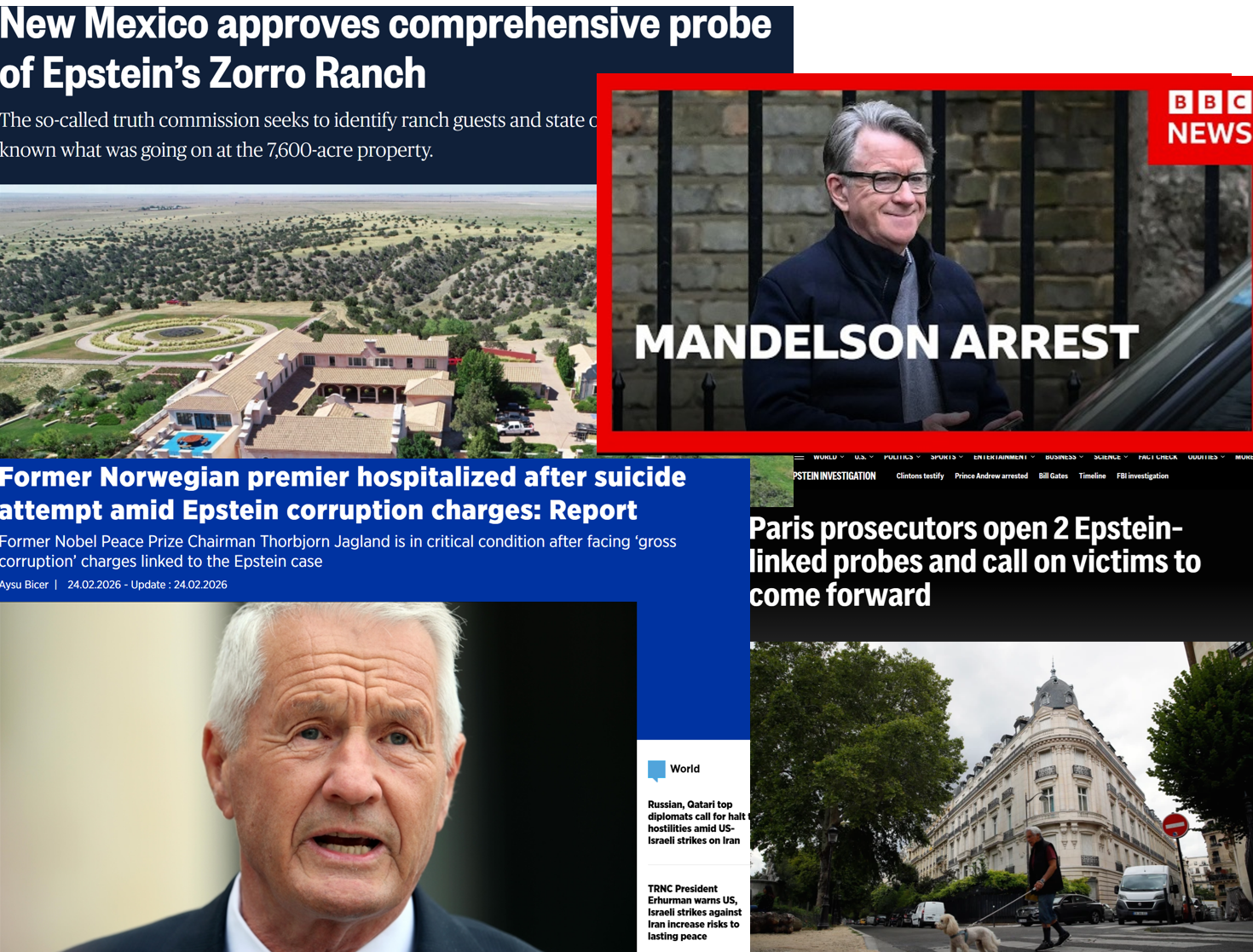
Around the world, investigations, resignations, and arrests of government officials are occurring in Slovakia, Norway (where one of the accused attempted suicide), France, and the United Kingdom. United Nations experts are claiming that Epstein’s actions may constitute crimes against humanity.
Despite these pervasive connections, official federal action within the United States has remained strikingly limited. New Mexico’s Attorney General’s Office recently reopened a criminal inquiry into Epstein’s Zorro Ranch. Meanwhile, House Democrats conducted a contentious closed-door deposition with Leslie (Les) Wexner, the billionaire founder of L Brands and the former head of Victoria’s Secret and Abercrombie & Fitch. Wexner, whom newly unredacted Federal Bureau of Investigation (FBI) files from 2019 identify as one of Epstein’s co-conspirators, is widely regarded as the primary architect of Epstein’s wealth.
The proceedings drew significant attention due to a viral exchange in which Wexner’s attorney, Michael Levy, was caught on a hot mic jokingly telling his client he would “f***ing kill” him if he answered another question with more than five words. However, the most profound revelation was Wexner’s claim that the FBI had never contacted him regarding his relationship with Epstein. This assertion represents a major development, as it suggests that a figure named as a co-conspirator in the DOJ’s own records, who is known as Epstein’s “financial benefactor,” and whose properties were allegedly used for illicit activities, was never a primary subject of federal investigation. The government’s failure to dispute this claim reinforces a growing public sentiment that the individuals within Epstein’s orbit remain insulated from legal accountability.
In fact, recent polling underscores a deep public cynicism; nearly 70% of Americans believe the Epstein saga proves that powerful individuals in the U.S. are rarely held accountable for their actions. Relatedly, even people who support Trump disapprove of his handling of the Epstein files, as a poll showed that a majority of Americans disapprove of Trump, but even more disapprove of his handling of the Epstein investigation. Indeed, some Trump supporters have expressed profound outrage, creating online content that eviscerates the administration for its callous response toward the survivors.
This week provided further evidence that the Trump administration is failing to be transparent in its release of the files. Journalist Roger Sollenberger on Substack and National Public Radio (NPR) found that the DOJ, which is supposed to release all files unless they are part of an ongoing investigation and can only redact the names of survivors, withheld and removed previously released files related to allegations that Trump sexually abused a minor between the ages of 13 and 15 years old. In response, Democrats, who lack the majority and thus the power in the House to subpoena, are launching an investigation into the allegations of Trump both withholding files and removing once-public files. Meanwhile, the DOJ says it is investigating whether or not files were accidentally withheld.
The persistent lack of transparency, the failure to release the complete archives as the law requires, and the absence of rigorous investigations have fueled a profound sense of public frustration. At the same time, an analysis of the files and reporting continues to offer more clarity about how the story is not about Jeffrey Epstein the person; it is about the class of people he was centered around and how their attitudes and behaviors regarding insider trading, sexual abuse, intelligence, and public relations manipulation were done with impunity.
The Web of Exploitation: Lures, Pageants, and the Modeling Front
The files continue to offer clarity about the methods Epstein and his co-conspirators used to exploit victims. Central to Epstein’s power was the network of elites he cultivated across a broad array of professional sectors. For example, recovered emails show Epstein coordinating a dinner with Cass Sunstein, the Robert Walmsley University Professor at Harvard Law School, and Kathryn Ruemmler, who recently announced her resignation as Chief Legal Officer and General Counsel of Goldman Sachs following her tenure as White House Counsel to President Barack Obama. They were joined by Peter Thiel, the billionaire co-founder of PayPal and Chairman of Palantir Technologies, and filmmaker Woody Allen. These gatherings appear to have been a regular part of his scheduling and networking efforts, facilitating his proximity to influential figures in law, finance, technology, and the arts.
Survivors have explained that under the guise of modeling opportunities, victims were frequently recruited from locations as far as South Africa. Epstein utilized his genuine connections to top models and Victoria’s Secret as a lure to draw young women into his orbit. Similarly, Epstein and Ghislaine Maxwell leveraged their influence within the art world to identify and prey on additional victims. The Epstein estate seemingly acknowledged the weight of these allegations this week by agreeing to a settlement of up to 35 million dollars to resolve survivor claims. This may explain why Maxwell’s legal team is currently fighting the release of documents from a since-settled civil defamation lawsuit brought a decade ago by Giuffre against Maxwell.
Epstein and Maxwell were not alone in these practices. Co-conspirator Jean-Luc Brunel was found to have used international beauty pageants as a front to exploit victims. According to reports from the Wall Street Journal, Brunel was reportedly willing to testify against Epstein prior to being found hanged in his jail cell. Interestingly, Epstein had expressed a willingness to cooperate with authorities before his death, which was also officially ruled a suicide.
Concierge Corruption: The DEA, Border Patrol, and the Five-Year Probe
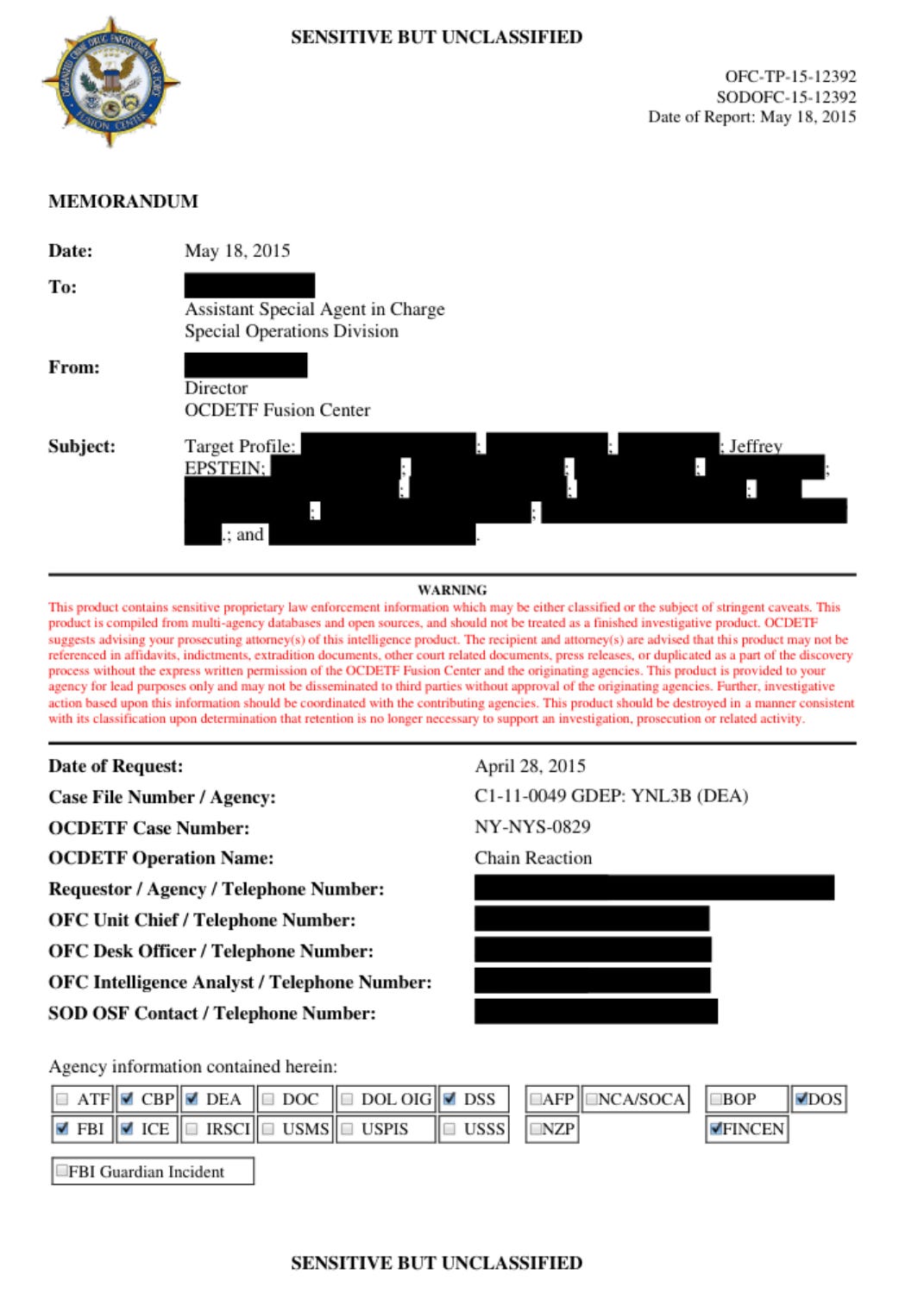
Recent revelations from the millions of files released by the DOJ offer further evidence of Epstein’s complex relationship with the federal government and the recurring failure of federal agencies to translate their investigations into convictions. The documents reveal that Epstein cultivated chummy relationships with several U.S. Customs and Border Protection officers stationed near his private island in St. Thomas. These interactions, which included Epstein providing food, financial advice, and even musical performance opportunities on his island, prompted a 2019 criminal investigation into whether officers provided him with concierge services to bypass standard inspections.
Relatedly, the files confirm that Epstein was the subject of a previously undisclosed five-year Drug Enforcement Administration investigation. This investigation, which began in 2010, scrutinized Epstein and fourteen associates for suspicious wire transfers totaling fifty million dollars potentially linked to narcotics and prostitution. This discovery is particularly noteworthy given long-standing allegations regarding Epstein’s involvement in the 1980s Iran-Contra scandal alongside Wexner, which reported connections to the transport of illicit substances into the United States during the Reagan administration.
New details have shed light on the initial investigation into Epstein’s death, revealing that federal authorities were deeply concerned by early leaks. Specifically, the FBI launched a probe into an anonymous 4chan user who posted a detailed account of Epstein’s death, including the mention of cardiac arrest and the specific time, nearly 38 minutes before the news was broken by major media outlets. Investigators sought to determine if the poster was a first responder or a facility staff member who breached protocol by sharing sensitive information online. Relatedly, an internal DOJ email from August 2019 reveals a staffer referring to Epstein’s death as a “murder.” While the official ruling remains suicide, the use of such language within federal communications has fueled persistent skepticism.
Partisan Shields: The Legislative Fight Over Censure and Complicity
Prominent figures with past ties to Epstein are now facing significant professional fallouts. Former U.S. Senator Bob Kerrey resigned from the board of a Nebraska clean-energy startup this month following renewed scrutiny of his association with the financier. Similarly, George J. Mitchell, the former Senate Majority Leader celebrated for brokering the Good Friday Agreement, has faced a severe reckoning. In response to the recent file releases, Queen’s University Belfast removed a bronze bust of Mitchell and stripped his name from its Institute for Global Peace, Security, and Justice. Furthermore, the U.S.-Ireland Alliance announced it would rename the prestigious George J. Mitchell Scholarship.
In the political sphere, the newly released files have sparked intense partisan debate and accusations of selective accountability. Representative Stacey Plaskett, the delegate for the U.S. Virgin Islands, has faced sharp criticism after text messages revealed she was in active contact with Epstein during a 2019 congressional hearing. In a reported partisan compromise to shield Plaskett from a Republican-led censure, Democratic leadership allegedly reached an agreement to stall the forced removal of Florida Representative Cory Mills. This arrangement occurred despite an ongoing House Ethics Committee investigation into Mills regarding allegations of sexual misconduct and harassment.
Finally, congressional attention has focused heavily on the Clintons. On February 26, 2026, former Secretary of State Hillary Clinton testified in a closed-door deposition, maintaining that she had no knowledge of Epstein’s crimes and denying that she ever met him, despite Ghislaine Maxwell’s attendance at her daughter’s wedding. The next day, former President Bill Clinton underwent hours of rigorous questioning regarding his extensive history with Epstein. The inquiry was intensified by the release of photographs from the files showing the former president on a private plane and in a pool with individuals whose faces remain redacted; a measure intended to protect the identities of potential survivors. Congressional investigators focused specifically on flight logs documenting at least 27 trips Clinton took aboard Epstein’s private aircraft, often referred to as the Lolita Express, and White House visitor records indicating that Epstein visited the executive mansion 17 times during the Clinton presidency. During his deposition, Clinton maintained that he had no knowledge of Epstein’s criminal activities and insisted that he had severed all ties with the financier years before the initial 2008 prosecution in Florida.
Degrees of Separation: Resignations and Revoked Chairs in the Ivy League
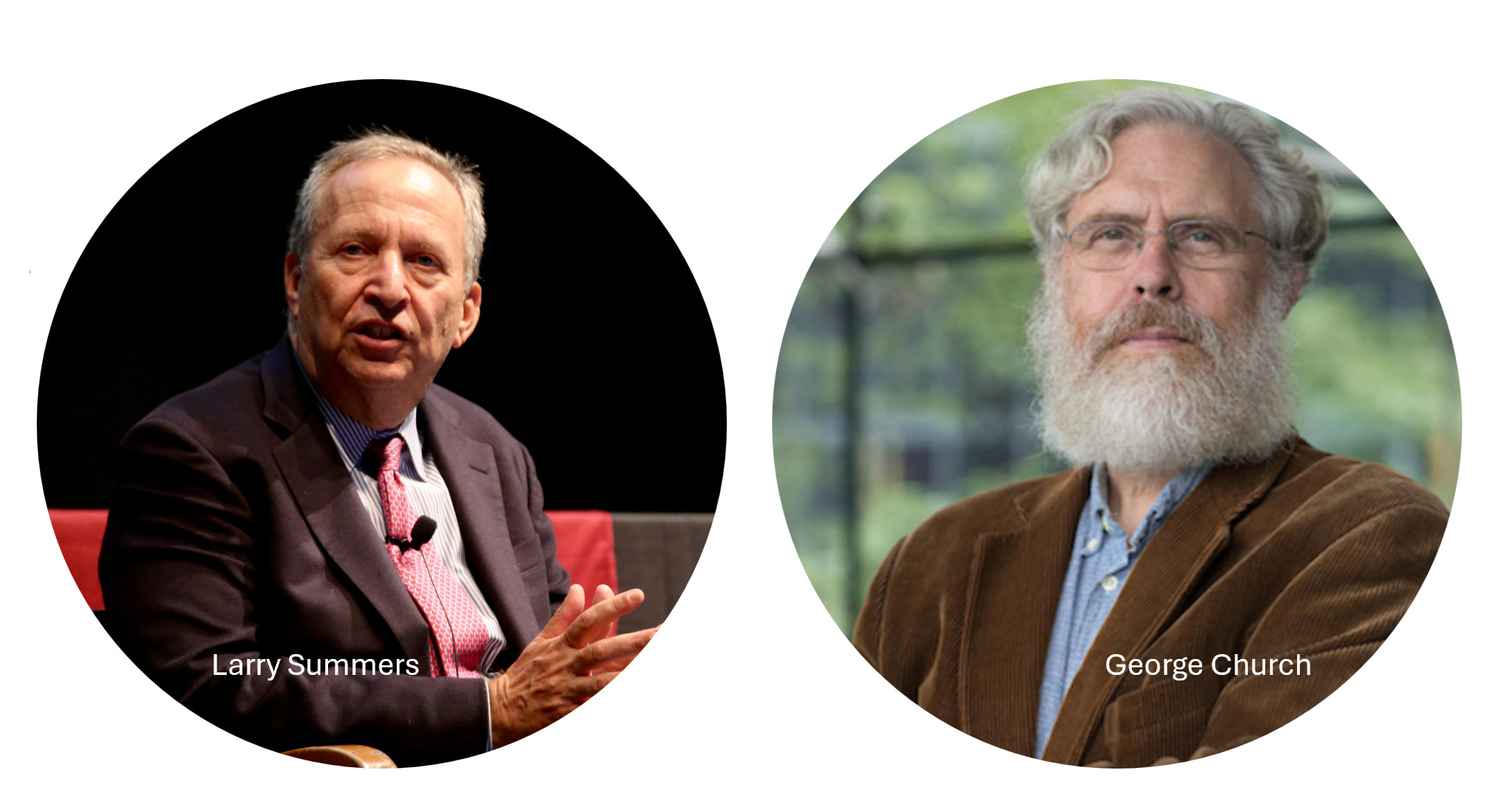
The fallout from Epstein’s extensive ties to academia continues to intensify as institutional scrutiny reveals deep-seated connections across the Ivy League and beyond. Recent reports indicate that Harvard University genetics professor George Church and his laboratory allegedly mishandled or utilized tissue samples funded through Epstein’s network. Church is just one of several high-profile Harvard figures linked to the financier, a list that includes Lisa Randall, Martin Nowak, Andrew Farkas, and Lawrence Summers.
Due to the nature of his professional and personal relationship with Epstein, Nowak was placed on administrative leave in June 2025. This disciplinary action followed a series of internal reviews into the funding Nowak received for his research center at Harvard, which was allegedly facilitated by Epstein long after the financier’s initial conviction. This week, Lawrence Summers announced his resignation from Harvard following revelations regarding his close relationship with Epstein. The departure was precipitated by the leak of sexist remarks and a disturbing conversation in which Epstein was suggested as a wingman to help Summers exploit a graduate student. Students are also lobbying to strip Leslie Wexner’s name from a prominent building on Harvard’s campus.
Harvard is far from alone in this crisis. Dartmouth is facing mounting pressure to rename a building dedicated to Leon Black, an associate of Jeffrey Epstein who has been accused of sexual misconduct involving a minor. As Wired notes, outrage over Epstein’s associations spans the educational spectrum from small arts schools to major public universities. At the School of Visual Arts, David A. Ross, the chair of the MFA Art Practice program, resigned following a targeted flyer campaign. Leaked emails from 2009 revealed that Ross had responded favorably to Epstein’s proposal for a statutory-themed art exhibition featuring minors.
Similarly, at University of California, Los Angeles (UCLA), associate adjunct professor Mark Tramo faces a petition for termination with over 10,000 signatures. Correspondence showed Tramo pitching research funding to Epstein while dismissively characterizing Epstein’s 2007 legal convictions as mere peccadilloes. While others attempt to manage the public relations fallout, Nobel laureate Richard Axel recently announced his resignation as co-director of Columbia University’s Zuckerman Mind Brain Behavior Institute, citing his own ties to the late predator.
Silicon Valley’s Dark Mirror: Blackmail, Palantir, and the Israeli Mission
The release of DOJ files has provided new evidence regarding Epstein’s extensive involvement in the technology sector, where he sought to cultivate relationships with both sovereign states and private corporations. Most notably, Epstein leveraged his long-standing relationship with former Israeli Prime Minister and Defense Minister Ehud Barak to facilitate business ventures and introductions. Documents indicate that Epstein helped orchestrate Barak’s involvement with firms such as Palantir Technologies, which was co-founded by billionaire investor Peter Thiel. Epstein’s own financial interests were frequently aligned with Thiel.
The unsealed files have intensified scrutiny of Bill Gates’s connection to Epstein. Recent reports suggest Epstein may have attempted to blackmail the Microsoft co-founder by threatening to expose an extramarital affair, during which Gates allegedly contracted a sexually transmitted disease. According to these accounts, the blackmail scheme centered on claims that Gates had transmitted the infection to his wife and sought Epstein’s advice on administering antibiotics to her without her knowledge. While Gates has denied these specific allegations, he recently withdrew from several high-profile events, including a global AI summit, following the leak of internal emails. In a recent town hall with Gates Foundation employees, he admitted to an affair with a Russian national and acknowledged that his association with Epstein was a “catastrophic error in judgment.”
The professional fallout has extended to other prominent figures in the engineering and biotechnology fields. Dean Kamen, the inventor of Segway and founder of the nonprofit FIRST, resigned this week from the board of directors of Beta Technologies, an electric aircraft manufacturer. Kamen’s departure followed the release of DOJ documents showing he maintained a personal relationship with Epstein and visited the financier’s properties well after his initial 2008 conviction.
Epstein reportedly sought access to the inner circles of the hacking community, frequently expressing interest in attending major conventions such as DEF CON and Black Hat. As a direct result of these disclosures, DEF CON recently announced a permanent ban on several technologists for their roles in attempting to facilitate Epstein’s access to the hacking community and providing him with technical advice.
The Corporate Reckoning: Apollo Global, Pension Protests, and the NFL
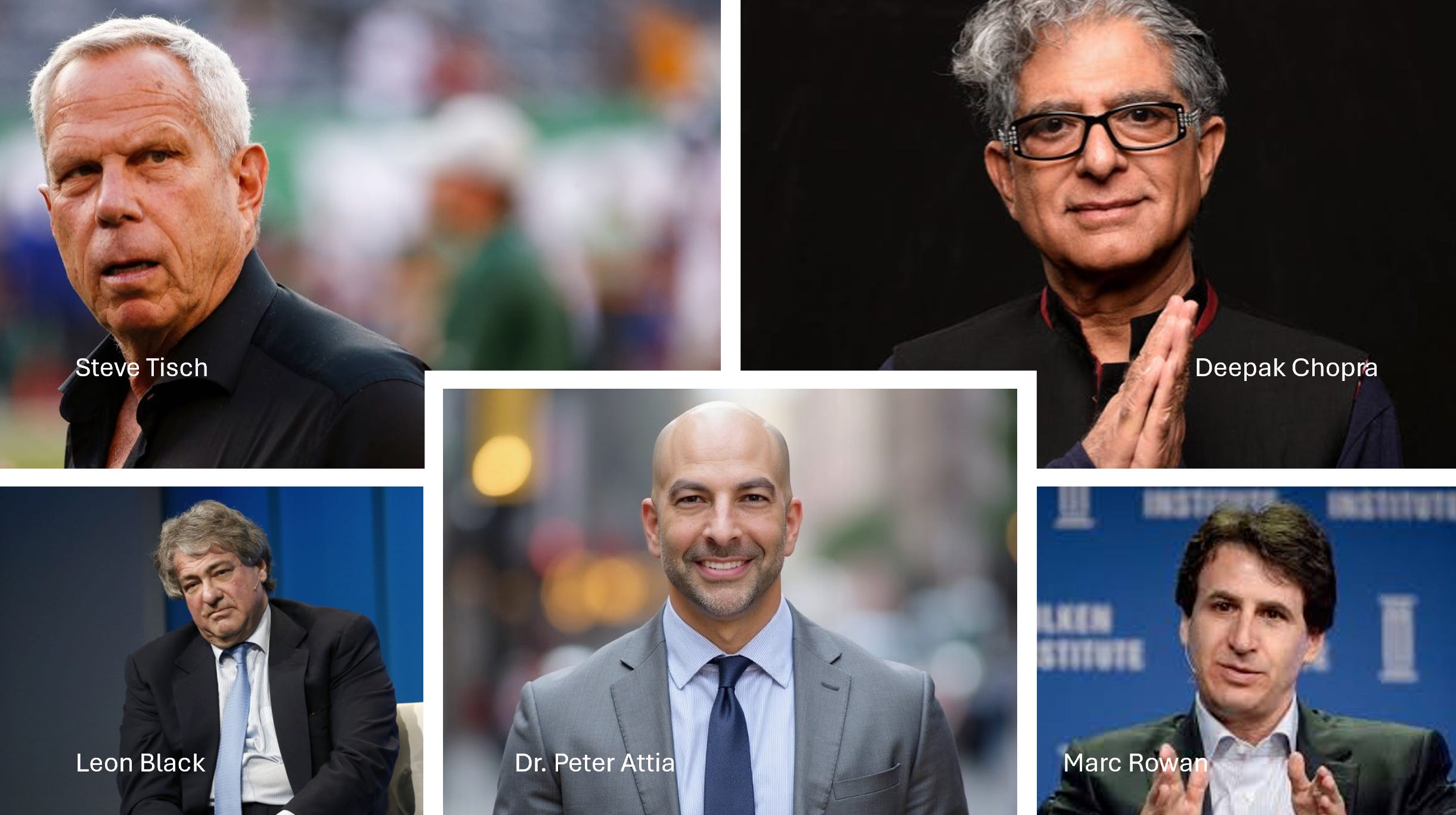
Given the wide net Epstein cast across broad sectors of society, the pressure for individuals to justify their associations or vacate their positions has become a pervasive force. Dr. Peter Attia, a prominent longevity expert, resigned as a CBS News medical contributor in February 2026 after released files revealed an extensive and personal relationship with Epstein. Meanwhile, wellness guru Deepak Chopra is currently facing intense public scrutiny following the release of DOJ files that include hundreds of messages exchanged with Epstein between 2016 and 2019. The correspondence reportedly includes instances where Chopra encouraged Epstein to bring “girls“ on trips, suggesting that they “would love it.” Similarly, the sports world has been drawn into the fallout; Steve Tisch, the co-owner of the New York Giants, has faced criticism after logs revealed Epstein coordinated meetings for him with various women, prompting an NFL inquiry into potential violations of the league’s personal conduct policy. This pressure extends to the Olympic stage, as Casey Wasserman, the chair of the 2028 Los Angeles Olympics organizing committee, faces mounting calls to resign after flirty email exchanges with Maxwell surfaced in the latest document dump.
The “Epstein reckoning“ in corporate America has gathered significant steam, as highlighted by a February 2026 CNN headline. This fallout has reached local communities across the country, most notably in Metro Detroit, where school districts have suspended contracts with the photography vendor Lifetouch. The decision was fueled by parental concerns regarding the company’s parent firm, Shutterfly, which is owned by Apollo Global Management (AGM). Leon Black stepped down as CEO of AGM in 2021 due to intense scrutiny over his professional and financial relationship with Epstein.
Despite current AGM CEO Marc Rowan’s repeated assertions that no one at the firm besides Black maintained a business or personal relationship with Epstein, the Financial Times and newly released DOJ files indicate that Rowan himself participated in meetings and email exchanges with Epstein concerning tax matters and donor-advised funds throughout the 2010s. In response to these revelations, the American Federation of Teachers (AFT) and the American Association of University Professors (AAUP), which represent thousands of members whose pension funds are invested in Apollo, have petitioned the Securities and Exchange Commission to investigate whether the firm issued misleading statements to its investors. Critics argue that the “misleading” 2021 independent review used to exonerate current leadership failed to disclose the depth of these executive-level interactions.
Meanwhile, major financial institutions have come under renewed scrutiny as the 2026 document release reveals the persistence of Epstein’s banking network long after his initial conviction. Most significantly, files show that Morgan Stanley opened and maintained accounts for Epstein-linked trusts between 2015 and 2019. This discovery follows recent investigations into JPMorgan Chase, which revealed the bank processed over one billion dollars in suspicious transactions for Epstein, while labeling him as part of an elite “Wall of Cash“ client group. These continued revelations underscore the systemic failure of the financial sector to sever ties with Epstein, even as his crimes became a matter of public record.
Conclusion
The “Open Letter” that once sought to dismiss Julie K. Brown’s reporting as “fake news” has aged into a confession of the very gatekeeping the files expose. From the “sweetheart deals” of the DOJ to the boardrooms of newly consolidated media empires, the Epstein saga is not a collection of “stupid stories” or baseless conspiracies, but a roadmap of how the American elite maintain impunity. When the federal government redacts files involving a sitting President and billionaires like Wexner remain untouched by investigators, the “vaulted gates” remain firmly shut against the public interest. Ultimately, the 2026 disclosures prove that Epstein was never a lone predator, but a central node in a vast, protected class, an architecture of exploitation where intelligence assets, tech lords, and media titans coordinated to ensure that transparency was denied and accountability was reserved only for those outside the gates. However, the story does not end with impunity. By keeping the truth alive and demanding justice, a growing movement of survivors and citizens has begun to dismantle these vaulted gates, ensuring that no amount of power can forever shield the guilty from the reach of the people.
The Paper Trail of Panic The Crumbling Epstein Defense (March 2026)

“In an email exchange, Sir Richard Branson told Jeffrey Epstein he would love to see him again ‘as long as you bring your harem.’”
When that sentence appeared in my article, “The Epstein Class,” it triggered a request for a correction from The Virgin Group. Virgin, co-founded by Branson, offered a clarification:
“Richard used Epstein’s language (‘harem’) in a follow-up email and stated that the sports team were keen for the women to return. However, had the full facts been known, Richard would never have used this term and there would have been no contact with Epstein whatsoever.”
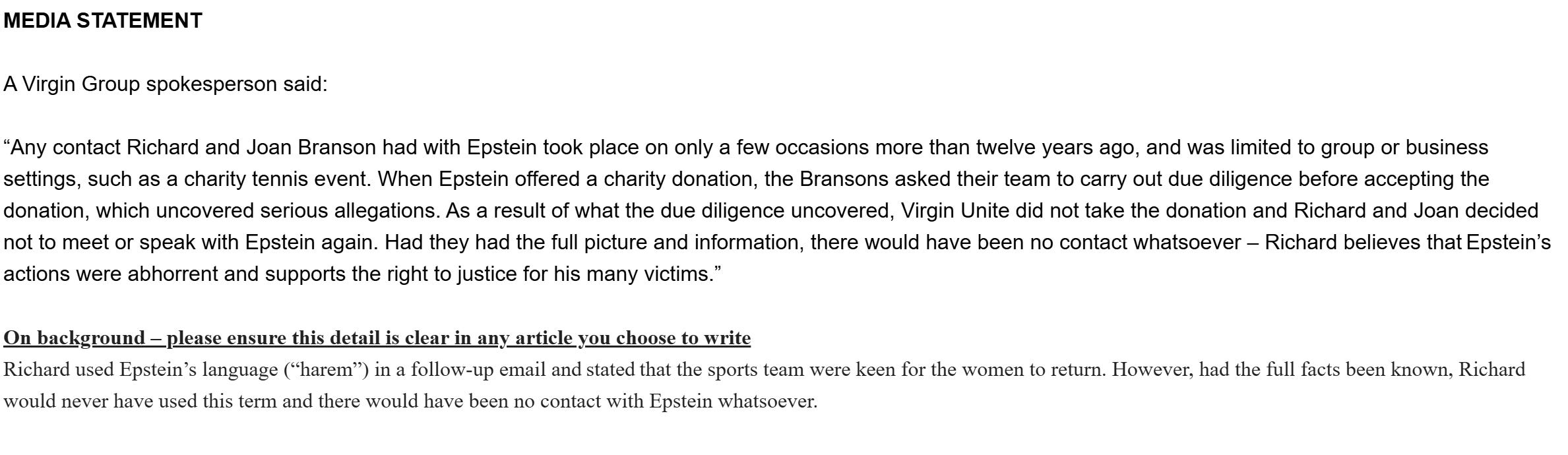
While Virgin’s referenced “follow-up email” remains presumably hidden from public view, the existing thread suggests some “facts” were uncomfortably clear. In the same exchange where he invoked the word “harem,” Branson wrote:
“I think if Bill Gates was willing to say that you’ve been a brilliant advisor to him, that you slipped up many years ago by sleeping with a 17 ½ year old woman and were punished for it, that you’ve more than learnt your lesson and have done nothing that’s against the law since and, yes, as a single man you seem to have a penchant for women. But there’s nothing wrong with that.”
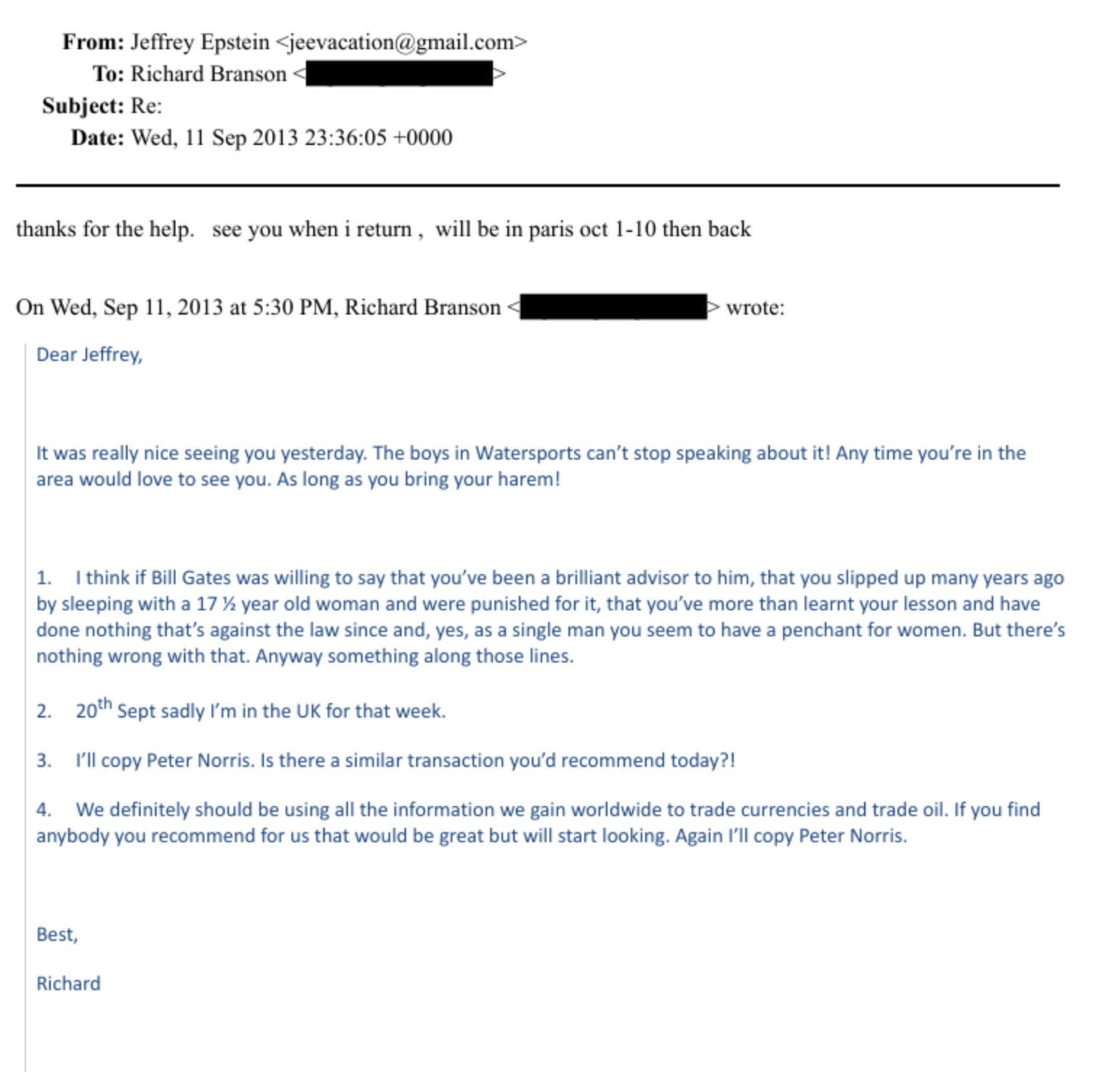
Epstein was convicted five years prior on charges of soliciting a prostitute and procuring a minor for prostitution involving victims as young as 14 years old.
Requests for “correction” such as these are more than mere PR housekeeping; they are a window into the panic currently rattling the corridors of power. Following the December 2025 release of Department of Justice (DOJ) documents, the ground has shifted beneath the “Epstein class.” Politico reports that the fallout from these files has ignited a hiring boom for elite lawyers, as numerous individuals listed seek aggressive counsel to shield themselves from both criminal prosecution and character assassination. Many of those named can no longer rely on the press for cover; even establishment media outlets, once dismissive of the saga, are now forced to navigate the grim complexities of the disclosures. Despite concerted efforts by the White House to stifle the narrative, the public’s demand for transparency has become an unstoppable force.
From Dismissal to Disclosure
In the decades prior to Jeffrey Epstein’s death in 2019, the establishment news media was frequently derided for dismissing evidence that Epstein was more than a “run-of-the-mill” sex offender. For example, New York Magazine (2002) and Vanity Fair (2003) published laudatory profiles of him. Vicky Ward, who authored the Vanity Fair piece, has since claimed that her reporting on Epstein’s sex crimes was suppressed by her editor. Similarly, reporter Amy Robach alleged that ABC News “quashed” her 2015 report on Epstein, a claim the network continues to deny. Epstein’s deep integration into establishment circles was so effective that outlets like Forbes (2013), National Review (2013), HuffPost (2017), and even The New York Times (2019) ran “soft” pieces on him long after serious allegations had entered the public record.
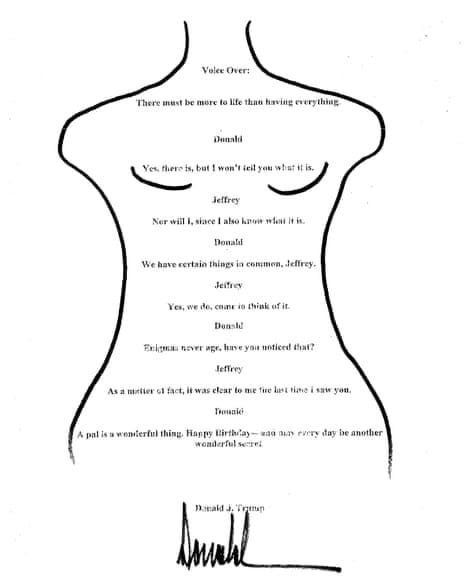
Following the initial document releases, the legacy press focused heavily on President Donald Trump, exemplified by the Wall Street Journal’s investigation into Trump’s contribution to Epstein’s “birthday book.” During this period, independent internet personalities and alternative outlets worked to synthesize complex theories into digestible narratives; Drop Site News, for instance, has extensively chronicled Epstein’s alleged ties to Israeli intelligence.
Recently, we entered a new phase in which the establishment press is finally treating the Epstein revelations with gravity, reporting on complexities that mirror the “internet discourse” of a decade ago. Notable recent developments include:
The New York Times published the exposé “Elite Doctors Served Jeffrey Epstein While Treating His ‘Girls,’” examining the medical professionals who enabled his lifestyle.
CBS and MSNOW (formerly MSNBC, which once dismissed questions regarding Epstein’s death as conspiracy theories) have conducted deep-dive reporting on the circumstances of his prison death, raising serious questions about the possibility of murder.
Politico reported that DC strategist Juleanna Glover engaged in a 15-month correspondence with Jeffrey Epstein shortly before his death, a connection she claims was strictly an attempt to leverage his resources to undermine Donald Trump.
Vanity Fair conducted a deep dive into the deposition records, detailing the extensive connections between Jeffrey Epstein and the Bill & Melinda Gates Foundation.
The New York Times published “Inside Jeffrey Epstein’s Push to Cleanse His Past Online,” detailing his efforts to manipulate public opinion through elite connections.
The Wall Street Journal has documented how Epstein appeared to leverage high-level relationships with figures like former Israeli Prime Minister Ehud Barak and former Barclays CEO Jes Staley to facilitate suspicious market activity and potential insider trading.
This reporting has led to significant public shaming for figures such as linguist Noam Chomsky, Tesla and X’s Elon Musk, economist and former United States Secretary of the Treasury Lawrence Summers, and Commerce Secretary Howard Lutnick, all of whom faced scrutiny as newly exposed ties revealed connections far deeper than they had previously acknowledged. More recent developments further illustrate the personal and institutional disintegration following these disclosures. In one instance, a pastor was suspended after her congregation discovered her previous role managing Jeffrey Epstein’s private island. Additionally, the wife of former Barclays executive Jes Staley has reportedly filed for divorce following his court admission regarding an affair with a member of Epstein’s staff. These incidents underscore how the unsealing of these records continues to dismantle the reputations of those once insulated by their proximity to power.
The pressure has now transcended social embarrassment and entered the legal realm. As of March 17, 2026, the Republican-led Congress has subpoenaed former Attorney General Pam Bondi under the belief that she mismanaged relevant files. Bondi follows a line of high-profile testimonies, including Les Wexner of L Brands, Epstein estate executors Richard Kahn and Darren Indyke, and former President Bill Clinton and Secretary of State Hillary Clinton.
White House attempts to divert public attention from Epstein have largely faltered. Even amidst a chaotic global news cycle featuring the capture of Venezuelan President Nicolás Maduro, international threats toward Greenland, escalating protests in Minnesota, and the recent war with Iran; the public remains laser-focused on the Epstein saga. A recent Drop Site/Zeteo/Data For Progress survey indicates that a majority of Americans believe the Trump administration initiated the conflict with Iran, in part, to distract from the Epstein files. This sentiment suggests a pervasive belief that the administration is either seeking a diversion or that the official justification given by the White House (that Israel forced the war to begin) lends credibility to confidential human sources in the files who allege that Epstein was an Israeli intelligence asset and Trump is “compromised by Israel.” The public conviction regarding Epstein is so strong that internet users have rebranded the U.S. military operation “Operation Epic Fury” as “Operation Epstein Fury.”
In response to intensifying public pressure, the DOJ released interview memos from an alleged victim of Jeffrey Epstein’s network who claims she was trafficked to Donald Trump as a minor and subjected to physical and sexual abuse. On March 18, 2026, Senator Dan Goldman reviewed these allegations on the Senate floor before unveiling previously redacted documents that directly contradict Trump’s assertions that Epstein had been banned from Mar-a-Lago.
Pardon the interruption! I’m committed to keeping the latest news and research as accessible as possible, but sustaining this work—and expanding into new video content and collaborations—requires the support of our community. If you’re able, please consider becoming a paid subscriber for just $5 a month. Your support keeps this information flowing to readers and classrooms everywhere. If you can’t swing that right now, no worries! Simply sharing this post or sending it to a friend helps us tremendously with the algorithms. Thank you for being here and for your support. Now, back to the essay!
The Fragility of the “Context” Defense
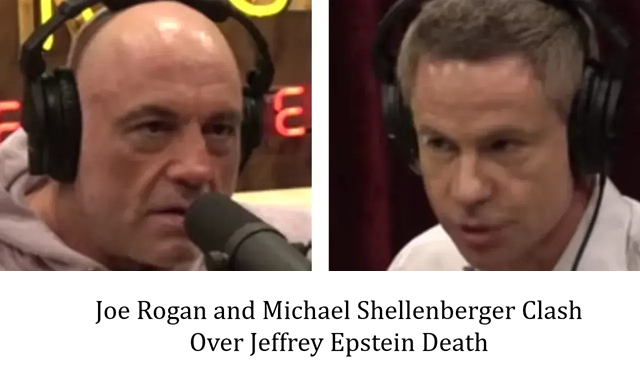
Despite the mounting evidence, some media voices continue to argue that the Epstein files lack a “smoking gun.” Journalist Michael Shellenberger, for instance, faced intense pushback during a recent appearance on The Joe Rogan Experience for attempting to downplay evidence surrounding Epstein’s death. Similarly, Ankush Khardori argued in Politico and on CNN that further prosecutions are unlikely due to a lack of “compelling evidence.”
This skeptical perspective ignores several critical realities. The 3 million documents released by the DOJ remain heavily redacted, and the government continues to withhold an additional 3.5 million files. Furthermore, the bulk of Epstein’s financial records and estate files remain shielded from public view. To claim a lack of evidence before the totality of the discovery is seen is premature at best. Most tellingly, the files reveal that the government possessed enough information to identify ten unindicted co-conspirators, yet failed to pursue or even interview some of them, a significant omission that undermines the “nothing to see here” narrative.
The argument that evidence is lacking is further contradicted by the actions of major institutions. Bank of America (BofA) JPMorgan Chase, Deutsche Bank, and the Epstein estate all saw fit to pay substantial settlements to survivors. International authorities also clearly see grounds for action: Poland has opened a sex trafficking probe, Great Britain is investigating related insider trading, and New Mexico authorities are currently investigating potential crimes at Epstein’s Zorro Ranch. Just last month, a tipster provided authorities with photos of “grave-like plots” discovered on the property.
Khardori’s focus also overlooks the staggering breadth of the allegations, which extend far beyond sex crimes to include blackmail, bribery, visa fraud, money laundering, insider trading, treason, torture, murder, child-buying, and drug trafficking. Media narratives that focus solely on the “harem” and sexual misconduct are merely scratching the surface of a much larger alleged criminal enterprise.
Conclusion
If the momentum from the public, the press, and members of congress continues, the era of the “Epstein distraction” is over. For decades, the sheer gravity of these allegations was held at bay by a mixture of editorial cowardice and elite intimidation, but the current dam-break of DOJ documents and congressional subpoenas has rendered the old tactics of “corrections” and “context” obsolete.
As Virgin Group’s outreach suggests, the shift from social scandal to legal liability has left the establishment scrambling to control burn a fire that is already out of any single person’s control. Whether the truth lies in the millions of still-redacted files or the “grave-like plots” of Zorro Ranch, the public is no longer content with the surface-level narrative of a “run-of-the-mill” offender.
“Operation Epstein Fury” symbolizes a fundamental breakdown in trust, a signal that until the full scope of these crimes is laid bare, no amount of global chaos will be enough to turn the world’s eyes away from the shadows of the Epstein estate.
Breaching the Fortress: The Fight to Topple the Epstein Class’s Wall of Secrecy (April 2026)
“You’re my hero and you’re a hero to the world,” noted Sky Roberts as he spoke about his deceased sister, Virginia Giuffre, on April 25, 2026, the one-year anniversary of her death by suicide. In 2019, Giuffre drew vast media attention for her claim that the now-late financier and sex offender Jeffrey Epstein had trafficked her and forced her to have sex with multiple men, including the United Kingdom’s (U.K.) former Prince Andrew, when she was a teenager.
During the week of the anniversary of Giuffre’s death, Andrew’s brother, the U.K.’s King Charles III, visited the United States (U.S.). During the visit, Charles III refused an offer by Representative Ro Khanna (D-CA) to meet with Epstein survivors. The diplomatic trip comes at a time when there is significant public outrage over Epstein in the U.K. after it was revealed that Prime Minister Keir Starmer appointed Peter Mandelson as the Ambassador to the U.S., despite Mandelson’s known ties to Epstein. Mandelson is currently being investigated for fraud by the European Union.
For decades, Epstein’s survivors have faced a wall of resistance from politicians and the media in their quest for justice. Even after the DOJ released a small portion of its files—estimated at just 2% of the total—U.S. authorities have failed to charge any of Epstein’s alleged co-conspirators. The release of these records has been notably lopsided; survivors’ identities were publicly released while the identities of alleged co-conspirators were redacted until Congress stepped in. In the face of institutional resistance and withheld financial and Epstein estate documents, a fresh wave of investigations and litigation offers renewed hope for overturning the status quo and securing justice.
Barriers to Accountability: Redacted Records and Silence
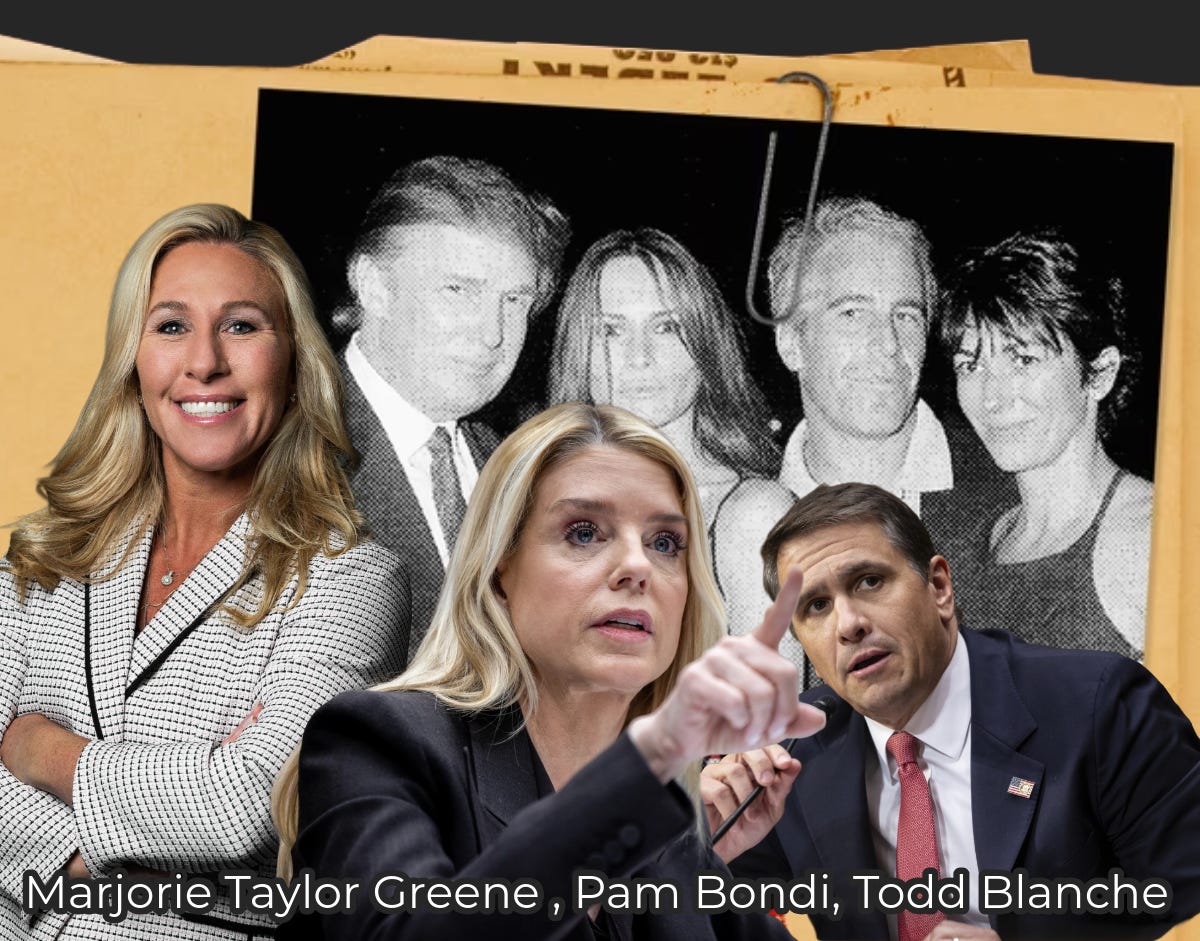
Former Attorney General Pam Bondi, who oversaw the initial release of the Epstein files before being relieved of her position, has been accused of orchestrating a cover-up. Critics point to a series of inconsistencies: Bondi famously claimed to have a list of Epstein’s clients on her desk only to retract the statement later. She then released previously public information while claiming it represented the files in their entirety. After the Epstein Files Transparency Act passed, her DOJ missed multiple deadlines to release the files. Even after some of the files were released, Bondi drew widespread condemnation for refusing to even look at survivors during a congressional hearing. Critics contend that Bondi’s removal from the DOJ may have been a strategic move to insulate her from oversight; by transitioning to the private sector, she may attempt to avoid her subpoena to testify before the House Oversight Committee.
Concurrently, the House of Representatives has faced accusations of stalling the investigation, as Republican leadership has moved to shut down several hearings requested by Democrats. Other people in the White House such as Acting Attorney General Todd Blanche and First Lady Melania Trump have blamed survivors for a lack of justice, arguing that they need to testify in public.
Critics contend that Trump is responsible for the alleged cover-up. Trump’s decision to file a failed lawsuit against The Wall Street Journal for publishing a sexually suggestive birthday message Trump reportedly sent to Epstein is seen as an effort to silence press coverage of the files. Former Representative Marjorie Taylor Greene (R-GA) has alleged that President Trump “flat out“ told Bondi not to release the Epstein files, claiming he expressed a desire to protect friends from potential trouble. Rather than his friends, Trump may be motivated to protect himself as the files reveal that Trump was accused of sexually assaulting and violently striking a girl between the ages of 13 and 15 years.
Reportedly, Trump and some Republican congresspeople’s efforts to silence the story may include a pardon for the only person currently serving jail time for Epstein’s crimes: his longtime associate, Ghislaine Maxwell. This comes after reported that Maxwell recently sent a USB to the DOJ that observers believe may contain damning information about Trump that Maxwell can leverage for a pardon.
Pardon the interruption! I’m committed to keeping the latest news and research as accessible as possible. However, sustaining this work and expanding into new video content and collaborations requires the support of our community. If you’re able, please consider becoming a paid subscriber for just $5 a month. Your support keeps this information flowing to readers and classrooms everywhere. If you can’t swing that right now, no worries! Simply sharing this post or sending it to a friend helps us tremendously with the algorithms. Thank you for being here and for your support. Now, back to the essay!
Curated Scandals: Why Legacy Media Ignores the Network
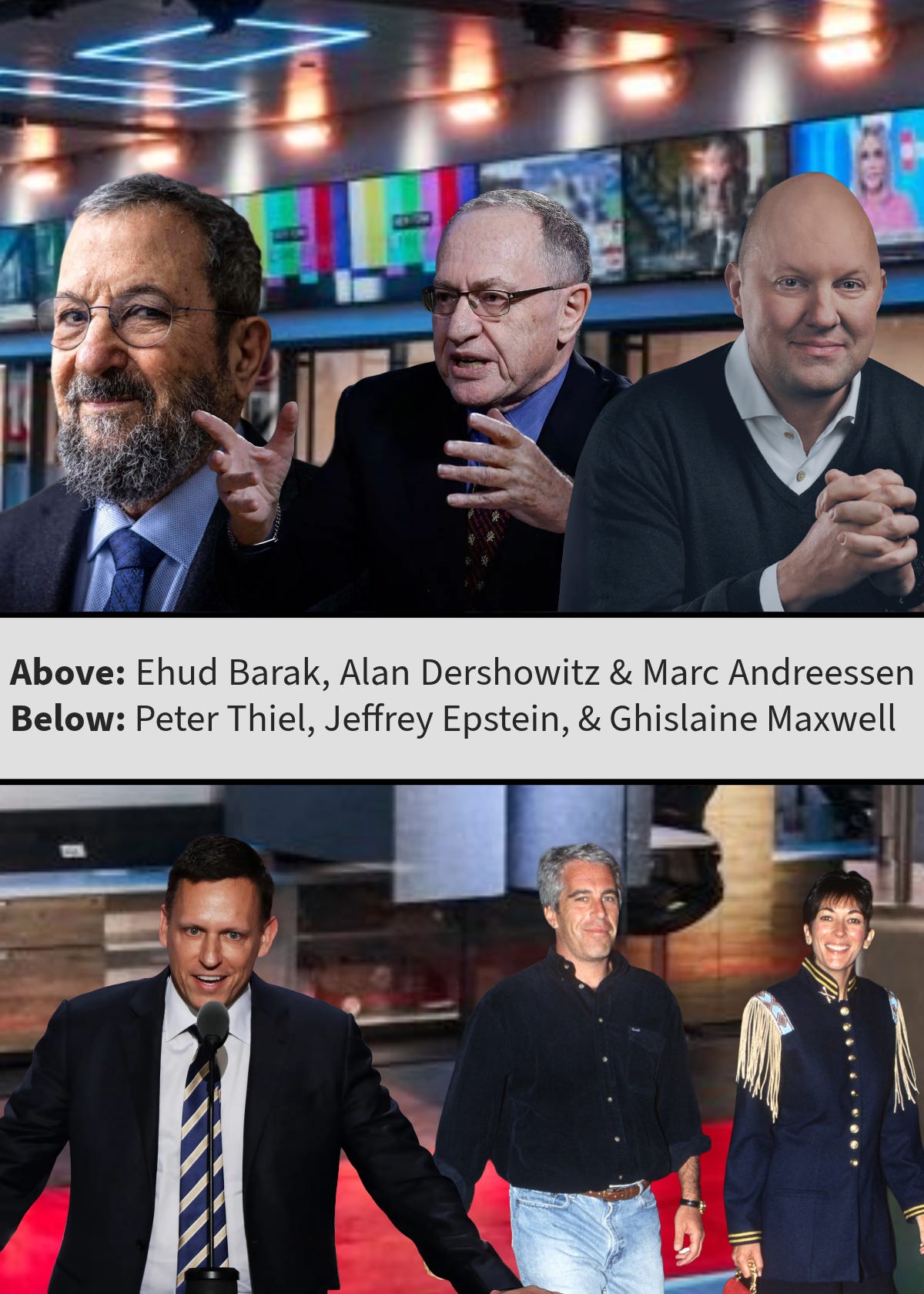
Despite competing headlines like the U.S.–Israel–Iran war, legacy news media have kept the Epstein story alive. Indeed, news media have provided substantive coverage of the Epstein case during Trump’s second term. For example, CNN recently reported on how released files indicate the Federal Bureau-Investigation (FBI) failed to follow up on survivors’ claims that Epstein trafficked them to high-profile individuals, including psychologist Dr. Henry Jarecki, wealthy banker Jes Staley, and Wall Street titan Leon Black. However, they continue to ignore that the allegations against Epstein and his associates extend far beyond sex crimes to include blackmail, bribery, visa fraud, money laundering, insider trading, treason, torture, murder, child-buying, and drug trafficking.
For example, in April 2026, CNN ran a segment that saw experts analyze the psyche of Epstein. It included home videos of him interacting with what appeared to be underage girls. In part of the segment, CNN aired audio of Epstein stating, “he said ‘there’s this company called [bleeped out].’ He said he mentioned to you.” CNN did not divulge that the bleeped portion referred to Lookout, a company owned by Peter Thiel of PayPal and Palantir Technologies. Nor did they mention that Epstein was chatting with the former Head of Israeli Military Intelligence (AMAN) and former Prime Minister of Israel, Ehud Barak (Download the entire conversation here). This might be relevant to audiences since the files include a confidential human source who claims in the files that Epstein, Alan Dershowitz, and Maxwell were Israeli agents and Trump was “compromised by Israel.”
The broadcast then cut ahead in the audio to reveal Epstein saying, “he thinks they’ll pay you a couple of million dollars to be on the board.” After yet another leap ahead, Epstein says, “you’re going to make a lot of money.” CNN did not note that later in their discussion, Epstein explained how Silicon Valley tycoons like Thiel and Marc Andreessen were paying individuals like former Treasury Secretary Larry Summers to “advise” their companies to get Barak on board. The intersection of private interests and public office—linking Andreessen and Thiel to figures like Barak and Summers—is exactly the kind of corruption-prone landscape that the press is supposed to scrutinize. Especially, because Epstein, Andreessen, and Thiel are all linked to the current President of the United States.
Cracks in the Wall: Investigations, Lawsuits, and Probes
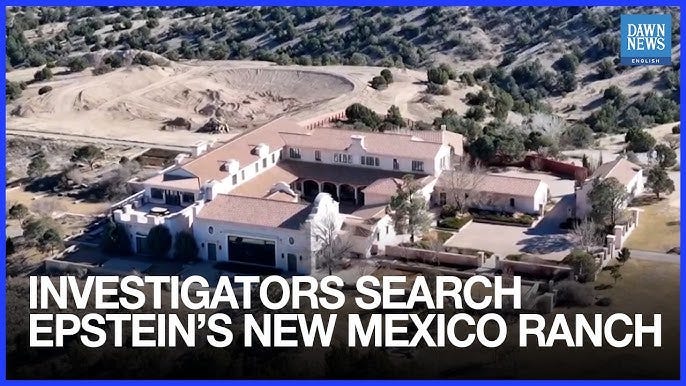
In the face of institutional chicanery and media negligence, a wave of new probes, lawsuits, and public pressure is creating a necessary path toward accountability. In February 2026, it was announced that New Mexico was investigating Jeffrey Epstein’s Zorro Ranch property. Since then, reports have indicated that the state deployed cadaver dogs and drones to the site. New York Post reports that the investigation has encouraged “multiple young men” who were “drugged” and “raped” at Zorro Ranch to come forward.
The investigation was launched, in part, because of an email sent in 2019 to a conservative radio host in New Mexico, which read: “Did you know somewhere in the hills outside the Zorro, two foreign girls were buried on orders of Jeffrey and Madam G? Both died by strangulation during rough, fetish sex.” The sender, using an encrypted email address, promised to send a USB drive with videos confirming the claims, though it remains unknown if the drive was ever delivered.
Similarly, in 2019, The New York Times reported that Epstein sought to “seed the human race with his DNA by impregnating women at his vast New Mexico ranch.” Giuffre alleged that Epstein had trafficked her to the late former New Mexico Governor Bill Richardson. This especially alarming given a significant procedural allegation regarding state authorities’ investigation into Epstein: New Mexico officials state they initially opened an investigation into the ranch in 2019 but were directed by the DOJ to cease their efforts. State officials claimed they assumed the federal investigation’s findings would be shared with them upon completion; instead, they allege the federal probe was halted without their knowledge, and the government has yet to disclose its findings to the state.
The DOJ is facing two investigations into its handling of the files. The Office of the Inspector General, an independent body from the Executive Branch, and the Government Accountability Office, an independent agency that is part of the legislative branch, are going to investigate the DOJ’s handling of the Epstein Files. Upon completion of the audit, the non-partisan watchdogs will publish a report.
In a legal challenge against the DOJ, journalist and former prosecutor Katie Phang filed suit against Acting Attorney General Todd Blanche on April 27. The lawsuit seeks the appointment of a special master to oversee the review and release of additional records related to Epstein. Phang, who covers these matters as an independent journalist, alleges that the DOJ has failed to comply with the 2025 Epstein Files Transparency Act through the use of excessive, unexplained redactions and the continued withholding of documents. Her suit contends that this lack of transparency directly hinders her ability to inform the public, arguing that the denial of access to these records creates a “concrete professional injury,” which prevents her from effectively performing her job.
In addition, the Bill & Melinda Gates Foundation recently announced an external review of its ties to Epstein. This decision comes after documents released by the DOJ raised new questions for major funders and partners, who have expressed concern regarding Bill Gates’ relationship with Epstein and the potential implications for the foundation’s reputation and governance. Indeed, the files include draft emails that Epstein appears to use as a tool for extortion, citing the procurement of medication for Gates to manage the consequences of sexual encounters with a Russian woman. Another draft accused Gates of ending their friendship while repeating lurid claims about a sexually transmitted infection. While spokespeople for Gates have denied these allegations, it has been widely reported that these ties contributed to the dissolution of his marriage to Melinda French Gates. In addition to his Foundation’s probe, Gates will testify to the House Oversight Committee later this year.
Redactions and Reputations: How Public Shaming Filled the Void of Official Accountability
Without justice being served and investigations only just beginning, public shaming has become the primary tool utilized against those named in the Epstein files. For example, shortly before the 2026 White House Correspondents’ Dinner, a large video of Trump and Epstein was projected onto the exterior of the host hotel. Relatedly, for over a year, numerous statues of Epstein and Trump have been appearing along the National Mall in Washington, D.C.
Meanwhile, even on matters ostensibly unrelated to Epstein, government figures such as Commerce Secretary Howard Lutnick and U.S. Senator Martin Heinrich have been hammered by the public for their past relationships with him. This social pressure appears to be having a tangible impact; for instance, Sarah Ferguson, the former spouse of Prince Andrew, withdrew from public events for over seven months after the extent of her relationship with Epstein was chronicled in the files.
The shame entered the White House in April 2026, when former Brazilian model and United Nations Ambassador for Youth Affairs Amanda Ungaro derided Melania on social media. Ungaro claims her ex-husband, the current United States Special Envoy for Global Partnerships Paolo Zampolli, pressured U.S. immigration officials to detain and deport her in 2025. Ungaro claimed to have sensitive information about the Trumps and warned Melania she intended to expose them. Ungaro was allegedly introduced to Zampolli by Epstein and her agent, the alleged Epstein co-conspirator Jean-Luc Brunel. It is widely believed that Epstein and Brunel used their deep connections to the modeling industry, which included other associates such as Leslie Wexner, to scout and traffic girls.
Shortly after the social media conflict, Melania called a press conference where she explicitly denied being “trafficked” to Trump by Epstein. Instead, she claimed that Zampolli introduced her to Trump in 1998 while he was still married. However, an FBI file contradicts this account, claiming it was Epstein who originally introduced Melania and Donald.
Conclusion
Despite Trump’s best efforts, the Epstein story refuses to fade. His life and connections remain a web of deep intrigue and a focal point in the ongoing search for justice. This fixation has even infiltrated popular culture, evidenced by a viral video game featuring characters based on the late convicted sex offender and financier Jeffrey Epstein, President Donald Trump, and the deceased scientist Stephen Hawking.
Furthermore, politicians seeking the White House have recognized a political opportunity in the demand for transparency. Representative Ro Khanna, for instance, took the unusual step of debating 20 Epstein skeptics on YouTube. As the public continues to demand answers, the intersection of political ambition and the quest for the truth ensures that the Epstein files remain at the forefront of the national conversation.
While the media often reduces this saga to a series of tabloid scandals and one pedophile, the evidence suggests a much more calculated infrastructure of influence and insulation. Virginia Giuffre died waiting for a transparency that remains largely redacted, buried under the weight of geopolitical interests and Silicon Valley boardrooms. Ultimately, the story of Jeffrey Epstein is no longer just about the crimes of one man, but about whether a system built on systemic corruption can ever truly be forced to look its survivors in the eye.
A Network Unravelling: Disclosures, Defiance, and the Ongoing Fight for Epstein Transparency (July 2026)
“Seven years ago today, Jeffrey Edward Epstein was charged by federal prosecutors in the Southern District of New York with operating a vast sex trafficking network to sexually exploit and abuse underage girls and young women between 2002 and 2005 at his mansions in Manhattan and Palm Beach, Florida” opened Julie K. Brown, the intrepid reporter from the Miami Herald who has covered the Epstein saga for the previous decade, in a July 8, 2026 Substack post. That same day, the National Post wrote “Epstein inquiry has found few answers Lawmakers and survivors are still looking for justice from Congressional probe” covering the one-year anniversary of the United States House of Representatives investigation into convicted late sex offender Epstein.
Since the House investigation began, a lot has changed. In November 2025, Congress passed and President Donald Trump signed the Epstein Files Transparency Act which ordered the Department of Justice (DOJ) to release all of its files into the investigation of Epstein. However, as a CBS investigation notes, all of the files have not been released, and many of the released files are redacting names and information that go beyond survivors. In fact, the DOJ was ordered in July 2026 by a judge of the United States District Court for the District of Columbia to release all of the remaining files, but refused.
The files that have been released show Epstein as a well-connected figure to people in finance, governments, intelligence, big tech, academia, and news media. As the one-year anniversary of the initial release of Department of Justice files approaches, numerous recent developments in investigative reporting, congressional inquiries, and government disclosures have shed further light and raised new questions regarding Jeffrey Epstein. (As a reminder, all previous coverage of Epstein and the Epstein files is available in chronological order here.)
Investigative Breaks
In addition to CBS’s reporting on the missing files, there has been other solid coverage on the Epstein saga. For example, in Regime Change: Inside the Imperial Presidency of Donald Trump, journalists Maggie Haberman and Jonathan Swan document how during the summer of 2025, the Trump administration met in the Situation Room without the President to decide how to address the release of the files. One of their key concerns was how allegations of sexual abuse of minors involving Trump in the documents would play out publicly, as Trump wanted those allegations and others kept out of the public discourse.
The student newspaper The Daily Pennsylvanian published a story titled “Inside Jeffrey Epstein’s attempts to recruit women from Penn,” documenting how Epstein pressured a woman who had just enrolled at the University of Pennsylvania to recruit women for him. This is especially concerning given that Epstein and his associates have been tied to numerous academic institutions, and the documents show him using his influence to get women accepted into colleges and universities.
The reporting about Epstein’s death continues to raise more questions than answers. Previously, both CBS and MSNOW did some strong reporting regarding inconsistencies in Epstein’s alleged suicide. However, in June 2026, The New York Times published reporting that included never-before-seen evidence and concluded that it was indeed a suicide. Despite citing a mishandled scene, inconsistent autopsy evidence, and reliance on incomplete records, there has been little pushback on The New York Times report. Nonetheless, adding to the intrigue, it was revealed that right before his 2019 arrest, Epstein moved millions of dollars through U.S. Virgin Islands banks and offered to provide dirt on Trump, presumably to stay out of jail. How these actions align with his death remain a mystery.
🛑 Pardon the interruption!
Please consider becoming a paid subscriber for as little as $5/month. Your support directly fuels this newsletter, our podcast, and crucial opportunities for student journalists to become the next generation of truth-tellers and media makers.
Federal, State & Foreign Probes
Numerous individuals have been called to testify before the House of Representatives committee investigating Epstein. Much of the testimony seemed to be an attempt to dodge complicity. For example, Goldman Sachs’s former top lawyer, Kathryn Ruemmler, who allegedly helped Epstein recruit National Security Agency (NSA) codebreakers, claimed to have known nothing about Epstein’s crimes when they met. She called Epstein a “Masterful Liar.” Similarly, Epstein’s alleged co-conspirator, Lesley Groff, also testified and argued that she never met any of the women Epstein abused and did not know their ages, something survivors claim is a lie.
Others seemingly saw their testimony as an opportunity to protect their associates. For example, longtime Bill Clinton aide Doug Band walked back a claim he previously made that Clinton visited Epstein’s island.
When Bill Gates of Microsoft fame testified, he failed to quell the scrutiny surrounding his relationship with Epstein. He called his friendship with Epstein a “grave error in judgment,” but said it was because he wanted to raise money for philanthropic ventures. Gates admitted he knew about Epstein’s crimes when he engaged in communication with him, and he also confirmed what the files revealed: that Epstein contemplated blackmailing Gates by exposing his extramarital affairs. Apparently, Gates’s testimony failed to convince Warren Buffett, as the billionaire decided to skip his annual donations to the Gates Foundation.
Similar to Gates, billionaire Leon Black testified in front of the House probe. Black stepped down as CEO of Apollo Global Management in 2021 due to intense scrutiny over his professional and financial relationship with Epstein, which included paying Epstein approximately $158 million for tax and estate planning services. Black denied that the two were close, even though in a birthday message to Epstein he wrote that they were “best friends.” Black, who is accused of sexually assaulting multiple women and is currently in a legal battle with the firm that represents some of his accusers, walked out of the hearing after Congress demanded he answer questions and hand over any non-disclosure agreements (NDAs) he had with the women.
Pam Bondi was fired from her position as Attorney General (AG) in Spring of 2026, just before she had to testify about the DOJ’s handling of Epstein. It is presumed that she was removed close to her testimony to avoid testifying in an open setting. Regardless, during her testimony, she refused to discuss Trump’s involvement in the release of the Epstein files by her DOJ.
Bondi’s replacement, acting Attorney General Todd Blanche, had a difficult time during his confirmation hearings to become Attorney General in July 2026 due to the DOJ’s handling of the Epstein files. Blanche was responsible for ignoring the court order in July 2026 to release the files. A month earlier, a judge ruled that by failing to release the files or present a legal defense for why they could not be released, Blanche was effectively admitting that the DOJ was defying the law. This followed the DOJ’s “embarrassing” attempt to claim that they could not release the files because they needed to be translated from another language, a claim rejected by the courts. Influential U.S. Senator Thom Tillis (R-NC) stated he would refuse to confirm Blanche’s appointment unless he met with Epstein survivors, a key demand after then AG Bondi refused to even look at them. Blanche agreed, but survivors claimed they were disrespected by the acting AG when they met.
Despite the administration’s lack of transparency in releasing the files, Congress is still moving forward. In July 2026, U.S. Representatives Ro Khanna (D-CA) and Thomas Massie (R-KY) introduced the Epstein Files Transparency Act II, which would give survivors and state attorneys general the power to sue the DOJ to force the release of the files. This places additional pressure on the administration. At the same time, pressure is mounting on powerful individuals as U.S. Senator Elizabeth Warren (D-MA) has sent a letter seeking information from JPMorgan Chase CEO Jamie Dimon about whether he took advice from Epstein.
In July 2026, House Democrats launched an investigation into whether Jeffrey Epstein acted as a foreign agent. This has long been rumored and is supported, at least tangentially, by claims in some of the files. In those documents, a Confidential Human Source (CHS) reported that Epstein was trained by the Israeli intelligence agency, Mossad, under former Israeli Prime Minister and Defense Minister Ehud Barak, and that lawyer Alan Dershowitz acted as the intermediary between Mossad and Epstein. Dershowitz recently refused to testify regarding the Epstein files. The foreign intelligence connection is particularly intriguing, as a CHS also claimed Trump is “compromised by Israel.” As part of Congress’s effort, Representative Jamie Raskin demanded that the federal government release all files regarding Epstein’s contact with foreign officials in a letter that alleged the late sex offender was a conduit between Saudi Arabia and members of the Trump administration, consulted with Russian officials on engaging with the president, and advised Barak.
One of the most promising locations for Epstein investigations in the U.S. is New Mexico. That is where Epstein’s Zorro Ranch is located, which is rumored to have been a place where people were killed, sexual assaults occurred, and Epstein’s work on gene editing may have been performed. Among these efforts is the Truth Commission, a bipartisan legislative committee established by the New Mexico House of Representatives that is tasked with investigating the systemic failures that allowed Epstein’s alleged abuse at Zorro Ranch to go unaddressed. Additionally, there is an investigation by the Attorney General of New Mexico. New Mexico has issued a high volume of subpoenas to obtain information from the federal government, but the state claims federal officials are stonewalling their efforts. At the same time, one of the reporters working on the New Mexico investigation has fled the U.S., alleging that she was the target of “direct energy weapons.”
Public Pressure & Reckonings
Some are not waiting for the reporting and investigations to take place and instead are demanding transparency. For example, in Great Britain there were protests at Buckingham Palace arguing that the royal family needs to explain what they knew and when regarding former Prince Andrew’s relationship and alleged crimes with Epstein. Similarly, in the U.S., an accuser has recently come forward testifying that while Epstein enjoyed a so-called “sweetheart deal,” a slap on the wrist for his original conviction which included being allowed to leave jail, he began sexually abusing her. A model and former friend of Melania Trump has now claimed that Epstein introduced Melania to Trump, fueling long-held rumors that Melania was trafficked to Trump.
Recent allegations also appear to have shed more light on Epstein’s associates. A beauty queen alleged that Trump’s beauty pageants, where he famously said he was allowed to “grab em [women] by the pussies,” were used to recruit women for Epstein. If so, this fits with other allegations that beauty pageants and modeling agencies owned by Epstein associates Jean-Luc Brunel and Les Wexner were used to attract women for trafficking by Epstein. Speaking of Wexner, 80 alums of The Wexner Heritage Program, which aimed to empower and expand the vision of Jewish leaders, have signed a petition demanding that the foundation take “meaningful action to support survivors of sexual violence and trafficking.” The Jerusalem Post posits that this may be “the largest organized accountability effort to emerge so far in the Jewish community’s reckoning with Wexner’s ties to Epstein.”
Electoral Fallout
Whether it be a talking point, a topic to avoid, or a source of funding, Epstein and his associates continue to play a major role in electoral politics. It is no secret that Vice President J.D. Vance is aiming for a presidential run in 2028. He has made the Epstein saga part of that effort, becoming the first U.S. official to claim Epstein was linked to the Israeli “deep state“ in an interview with Joe Rogan, where he also admitted that the Trump White House botched the Epstein files rollout. It is also believed that he is the one who leaked the Situation Room meeting about Epstein to Haberman and Swan to make himself look good by reporting that he wanted to release all of the files.
Meanwhile, other candidates are not so lucky, such as U.S. Senate candidate John E. Sununu, who is dodging questions about why his claim that he was not at an event with Epstein is contradicted by his campaign and the Epstein files. Meanwhile, Truthout found that the Epstein class has given $1.6 billion to candidates, 80% of which went to Republicans and conservatives, since the Citizens United ruling expanded the ability to donate money.
Conclusion: Censored Truths
“I actually heard Trump may come tonight but he couldn’t make it,…He got caught in sex traffic.” Exclaimed comedian Whitney Cummings at the July 2026 Kennedy Center presentation of the Mark Twain award to Bill Maher. The joke drew headlines but was cut from the final broadcast. It is a microcosm of the entire Epstein saga: a subject of public intrigue, political leverage, and open speculation that remains heavily censored, deliberately obscured, and endlessly shielded from full accountability.
Support This Work
If you find value in what I’m doing, consider becoming a monthly paid subscriber—it helps me keep the lights on and the content flowing.
Can’t swing a subscription right now? No worries. A like, comment, share, or subscription goes a long way in boosting visibility and helping this project grow.
The more we spread media literacy, the stronger our democracy becomes.
💥 Let’s build it together.
WIRED
We Tracked Every Visitor to Epstein Island
143K 👍🏿👍🏻👍🏽👍🏾👍 6,273,318 👀 views Nov 22 , 2024
Even in death, the secrets of disgraced financier Jeffrey Epstein and his infamous private island remain tightly guarded. But in 2024 WIRED conducted an investigation uncovering the data of mobile devices belonging to almost 200 of his visitors. How strong was the data? So precise that we followed visitor's movements to and from Epstein Island to within centimeters—tracking their countries, neighborhoods, and even buildings of origin.
This is Epstein Island’s Secret Data: On The Grid.
https://youtu.be/PjPHq-Ez0nc?si=wKmhjJgCmwMbfxU_
Being a survivor isn’t just about enduring pain… it’s about rebuilding, resisting, and rising. Every survivor’s story, every victim’s journey, is a testament to courage. And no one should have to heal alone. 🕊💞
“Your pain is valid, your strength is undeniable, and your voice matters 💞 … Clarity”